Affichage des articles dont le libellé est SFMTA. Afficher tous les articles

jeudi 18 mai 2023

Bike to Wherever Day

Bike to Wherever Day
By

Join people across the city bicycling today for the annual Bike to Wherever Day. The SFMTA is proud to be the official citywide sponsor of Bike to Wherever Day 2023, San Francisco's favorite biking celebration!   

A bicyclist with a backpack and helmet is seen in the street adjacent to a crosswalk.

Hosted by the San Francisco Bicycle Coalition, Bike to Wherever Day celebrates  bicycles as a fun and healthy way to get around. This annual event invites people to pedal to their destinations, and it promotes bicycling both as an alternative commute and as a healthy and safe alternative to driving to…wherever. 

We encourage everyone, including those who don't usually bike, to get out and cycle today. After grabbing some wheels  (your own or a bikeshare bike), consider joining one of the Neighborhood Rides. Need more reason to stop by? You also can pick up your free Bike to Wherever Day canvas tote bag, filled with goodies, courtesy of the SF Bicycle Coalition. 

Resources to Help You Plan Your Bicycle Trip 

The SFMTA has go-to resources to help you plan your bicycle trips.  The interactive bike network map highlights recommended routes and shows bikeshare station locations. Go to our Get Out, Get Going website  to find an interactive multi-mode map with information about other sustainable ways to get around that you could pair with your bicycle trip, including walking and using shared mobility devices, like a scooter or moped.   

The SFMTA supports low-carbon transportation options like bicycles, and we continue to expand our dedicated bike lanes around the city to make streets safer and more comfortable for bicycling.  

You can check out our Slow Streets Program with over 18 corridors  that have traffic limitations so they can be used as shared spaces with walkers and bicyclists. Biking, scooting and rolling  are integral to our new Active Communities Plan, a 2-year process to develop a plan for active mobility in San Francisco.  For more information, visit the project website (SFMTA.com/ActiveCommunities).  


Published May 18, 2023 at 11:20PM
https://ift.tt/yRUptsG

mardi 16 mai 2023

San Francisco To Extend Parking Meter Hours Citywide

San Francisco To Extend Parking Meter Hours Citywide
By Pamela Johnson

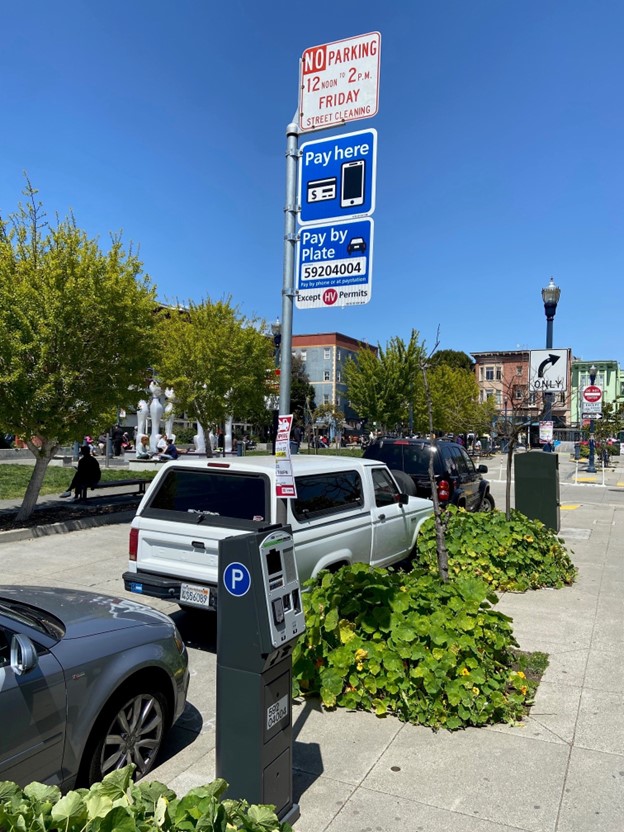
Cars parked along the sidewalk outside with pay station nearby and blue sky above.

Much like real estate, parking is at a premium in San Francisco. For decades, most parking meters in the city have operated from 9:00 a.m. until 6:00 p.m. Monday through Saturday. While drivers generally love free parking, they may not realize that it’s hard to find a space in the evenings and on Sundays in many neighborhoods because the meters are not running. 

Beginning in July 2023 and continuing in phases through December 2024, the SFMTA will extend parking meter hours until 10:00 p.m. Monday through Saturday and add Sunday meter hours from 12:00 p.m. until 6:00 p.m. Parking meters already operate in the evenings or on Sundays in some areas, including Mission Bay, South Beach, the 18th Street business district in Potrero Hill and along the Embarcadero. This extension will make meter hours more consistent citywide, create more parking availability and generate revenue to help the agency sustain vital Muni service. San Francisco has changed considerably since the current parking meter hours were introduced in 1947. Cities locally and around the country run their parking meters in the evenings and on Sundays because these days, many businesses are open then. Since parking spaces tend to turn over more quickly when meters are in operation, extending meter hours can help businesses by making parking more available and therefore allowing drivers to spend less time looking for a space. Fewer drivers circling the block to look for parking means reduced traffic congestion, less air pollution and fewer greenhouse gas emissions. 

Extending meter hours also will help the SFMTA address a potentially catastrophic budget shortfall. The agency anticipates a projected $130 million deficit starting in Fiscal Year 2025 due to COVID-19's ongoing effects. Without additional funding, we could be forced to eliminate as many as 20 Muni lines, which would disproportionately affect those with low incomes, people of color, older adults and people with disabilities.  

Evening and Sunday parking meter hours will be implemented in six phases over a period of 18 months, beginning with Dogpatch and Fisherman’s Wharf. To take into account historic inequities in San Francisco, lower-income neighborhoods whose residents are predominantly people of color will come last in the rollout. We also are in the process of replacing every parking meter in the city. The extended meter hour implementation is designed to follow behind the installation of new meters, which will have bigger, brighter and easier to use screens; operate in English, Spanish and Chinese; and are more resistant to vandalism. 

In the meantime, SFMTA staff will be doing extensive outreach and meeting with merchant groups, religious leaders, neighborhood groups and elected officials to discuss the program.  

We do understand that extending parking meter hours will impact people who drive to religious services on Sundays. However, those drivers likely will only have to pay for parking for a few hours, if at all, because the meters won’t begin operating until noon on Sundays. There also will be no time limits at metered spaces after 6 p.m. or at any time on Sundays, giving drivers the freedom to decide how much time to spend at dinner, a religious service or wherever they might be, without having to feed the meter repeatedly. Plus, thanks to the SFMTA’s Demand Responsive Parking Pricing program, drivers will often find less expensive parking meters just a block or two away from busier corridors.  

To learn more, visit the project website (SFMTA.com/ModernMeterHours).  


Published May 16, 2023 at 11:45PM
https://ift.tt/OTy4vX3

jeudi 20 avril 2023

Muni Improvements Draw Increased Ridership

Muni Improvements Draw Increased Ridership
By Kate McCarthy

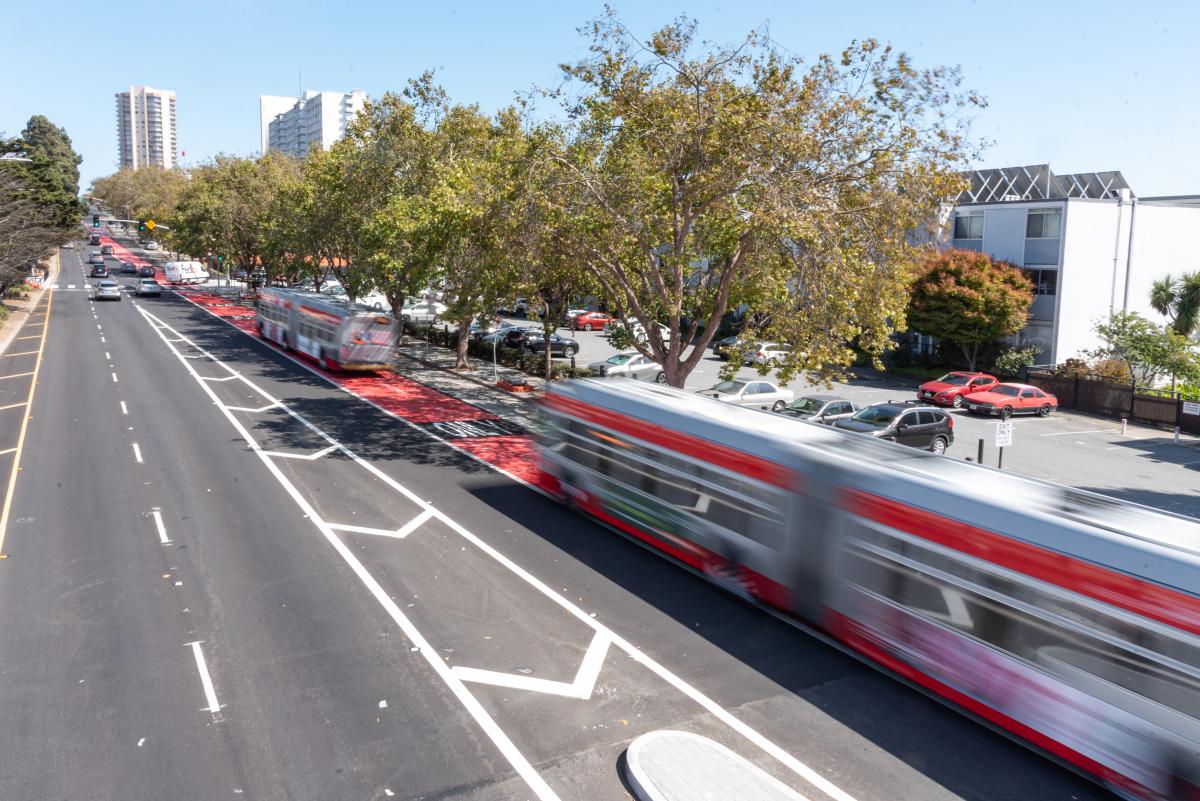
Buses driving towards downtown on Geary Boulevard.

38 Geary buses zip downtown on new transit lanes that improve travel times for Muni riders.

As Earth Day approaches and we think about how to encourage more people to take non-car trips, recent Muni improvement projects are drawing increased ridership across the city. While Muni ridership downtown has not yet rebounded to pre-pandemic levels, ridership has gone up on Muni lines where we have improved speed and frequency of Muni service. 

Muni is a lifeline for many of our riders: 70% of Muni riders have an annual income of less than $50,000. As we restored and added Muni service after the start of the pandemic, we invested in the routes that serve people who rely on transit and need it most. For example, after we installed transit lanes, increased frequency and re-routed the 22 Fillmore to bring people to their jobs and medical appointments in Mission Bay, ridership increased to 107% of pre-pandemic levels on weekdays and 118% on weekends. 

Since the start of the pandemic, we’ve implemented more than 21 miles of new transit priority lanes, growing our transit lane network (https://ift.tt/SIaVyfh) to over 70 miles. These transit lanes are improving travel times for Muni riders across the city. After transit lanes were installed on Mission Street in downtown, travel times on the 14 Mission and 14R Mission Rapid are now 31% quicker. 

Ridership numbers on the 49 Van Ness-Mission also blossomed to 109% of pre-pandemic ridership on weekdays and 114% on weekends after construction on the Van Ness BRT corridor was completed last April. With physically-separated transit lanes and transit signal priority that gives the green light to Muni and Golden Gate Transit buses, riders there are seeing travel times reduced by 35%. 

A similar story has emerged on San Francisco’s busiest transit boulevard — Geary. Like other lines that serve downtown, the 38 Geary hasn’t fully recovered to pre-pandemic ridership levels. But the route did nab a spot in the top 10 highest recovered routes in the Muni system. The 38 Geary’s 36,000 daily riders have recently seen travel time savings of up to 18% since we installed three miles of new transit lanes, bus stop changes and other improvements as part of the Geary Rapid Project. We plan similar improvements on the western end of the corridor as part of the Geary Boulevard Improvement Project.     

Muni riders have noticed that improvements to our busiest Muni lines are making service faster and more reliable than it has been in decades. Two-thirds (66%) of Muni riders who took our Annual Muni Rider Survey last fall rated Muni service as “good” or “excellent” — a 9% increase from 2021 and the strongest increase since 2018. 

These improvements can’t come soon enough. Most of San Francisco’s greenhouse gas emissions come from cars and trucks. As the urgency to address climate change mounts, so does the need to get the most out of our Muni system. To inspire riders to come back to Muni, we’re working hard to bring back the Muni system our city deserves: One that is thriving with the better frequency, improved reliability and better connections that these projects are delivering. 


Published April 20, 2023 at 10:54PM
https://ift.tt/xdwZIrT

mardi 18 avril 2023

There’s a Community Shuttle Coming to the Bayview

There’s a Community Shuttle Coming to the Bayview
By

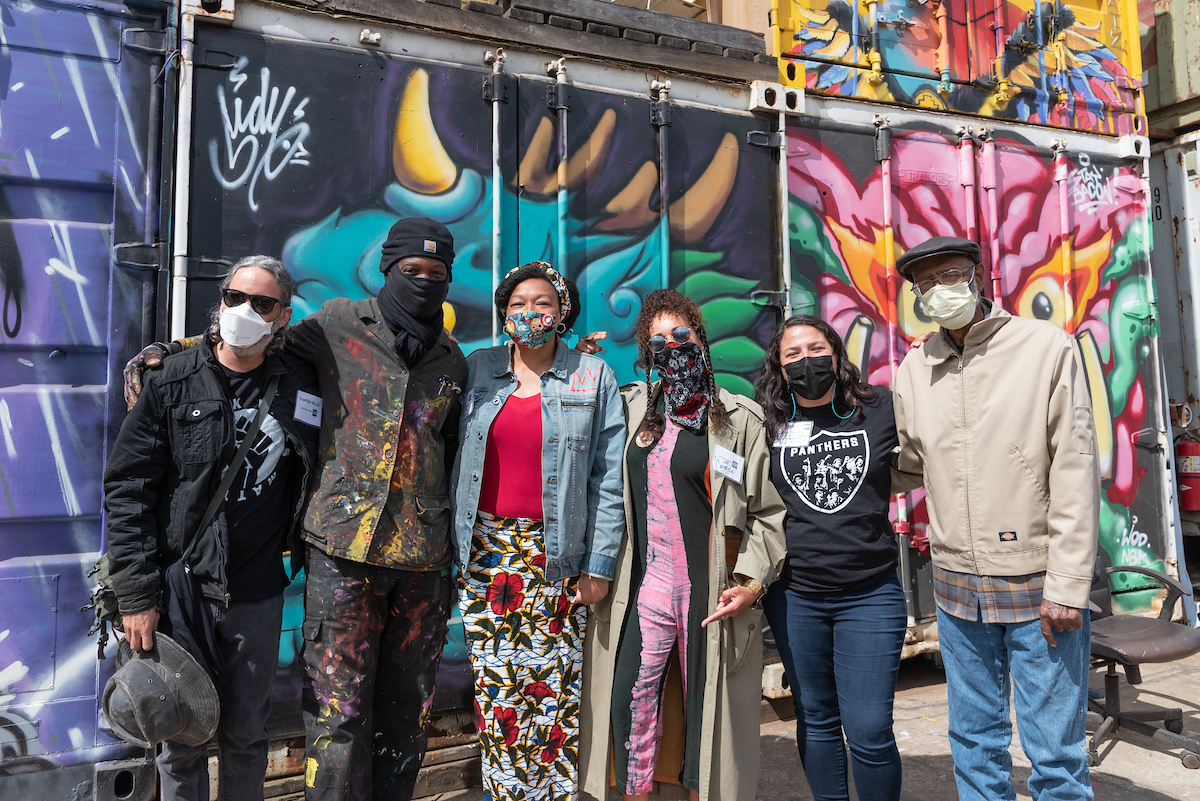
Several individuals with masks huddle for a group photo in front of a colorful mural backdrop in an our setting.

A new shuttle to serve Bayview’s diverse communities

A new community shuttle is coming to Bayview-Hunters Point in January of 2024, and we need your help designing it! The SFMTA is partnering with the California Air Resources Board and nine community-based organizations to launch a dynamic service community shuttle that truly meets your needs. A community shuttle has been a long-desired service for this geographically isolated community, and was identified as a top priority in the Bayview Community Based Transportation Plan. This program builds off of previous community shuttle efforts like the Bayview Moves program. To share your voice, take our survey now or attend one of our upcoming community partner events.

A “dynamic service” shuttle is one that doesn’t have a fixed route like a bus line, but instead operates in a “service area.” The shuttle will pick up and drop off riders anywhere within the Bayview area and connect them to hard-to-reach destinations like community centers, regional transit and grocery stores. Combined with Muni service, this program will help Bayview-Hunters Point residents get around more easily while reducing car trips and improving air quality.

A Community Shuttle only works if it is accessible, feels welcoming and gets people where they need to go. That’s why the SFMTA will be working with residents through the summer and fall of 2023 to build a service plan that works for the community.

This is where you come in. We want to know how you might use a shuttle like this. Would you use it during commute hours or on nights and weekends? Would you ride within your immediate neighborhood or to destinations like the 24th Street BART station and SF General Hospital? How long would you wait for a shuttle to arrive? Would you walk to the corner or a block away for a pickup? Answers to these questions will help us build a shuttle that meets your needs.

We want to establish shuttle service that effectively serves the people living in Bayview-Hunters Point today, and the more feedback we get, the better. You can get involved in the following ways:

This program also includes job training, a Community Congress that will provide project oversight, and a Third Street storefront for transit information and services. You can find more information on our Fact Sheet.


Published April 18, 2023 at 11:12PM
https://ift.tt/1NzH4rC

jeudi 16 mars 2023

Reimagining Potrero Yard – A Community Open House, Saturday, March 18

Reimagining Potrero Yard – A Community Open House, Saturday, March 18
By John Angelico

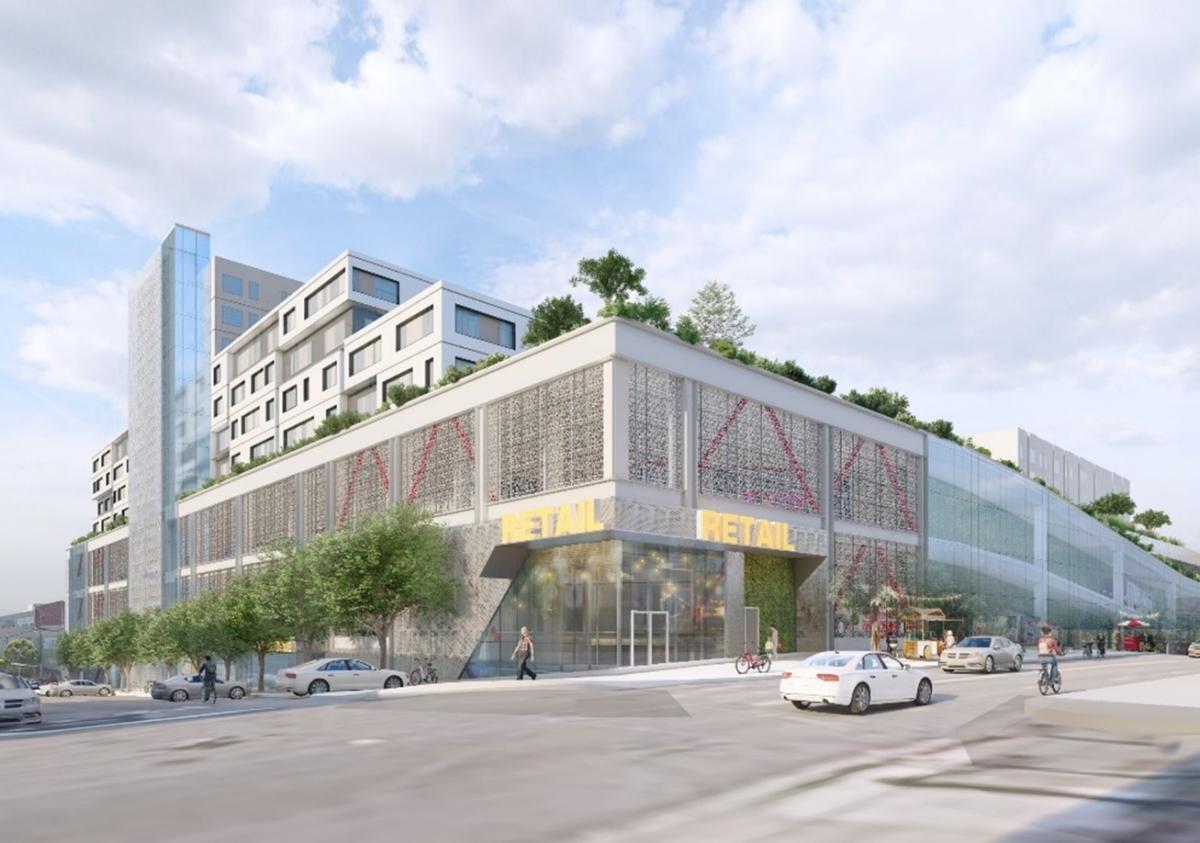
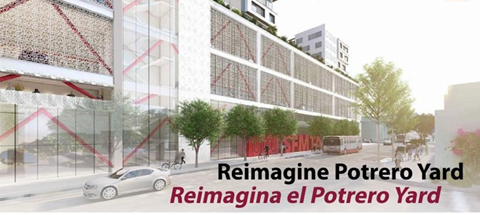
A rendered image of a modern multi-use building is seen from the street level intersection of 17th and Hampshire streets. At the corner, a retail establishment is seen. The first two levels of the building show industrial construction elements. Above those levels, housing units are seen along with greenery and trees. Pedestrians are seen on the sidewalk, a cyclist is seen in a bike lane, and vehicles are on the street.

This conceptual rendering shows one of the proposed spaces in the Potrero Yard project designated for small businesses and non-profits at the intersection of 17th and Hampshire streets. (Image: Arcadis IBI Group) 

This Saturday we’re joining the Potrero Neighborhood Collective (PNC) developer team to host a community open house for the Potrero Yard Modernization Project, the nation’s first joint development of a bus facility with integrated housing and retail. Learn about how we’re improving transit by replacing a century-old bus yard with a modern facility, as well as addressing SF’s need for affordable housing. Please join us to view the latest designs and give your input on this groundbreaking project.  

A rendered image of a modern multi-use building is seen from street level. There are trees on the street and signage is visible on the sidewalk in front of the building showing the Muni and SFMTA logos. Pedestrians are seen on the sidewalk, a vehicle is on the street and a Muni bus is seen in the background. The image is labeled in English and Spanish: Reimaging Potrero Yard; Reimagina el Potrero Yard.

Join us! Reimaging Potrero Yard. Saturday, March 18,  2023, 1-3 p.m. KQED, 2601 Mariposa Street, SF. (Conceptual rendering from Arcadis IBI Group)

What: Reimagining Potrero Yard Community Open House

Español - Reimagina el Potrero Yard. Sábado 18 de marzo, 1-3p.m. KQED, 2601 Calle Mariposa, San Francisco CA

When: Saturday, March 18, 1-3 p.m. 

Where: KQED building, 2601 Mariposa Street, San Francisco, CA 94110 

This event will be family-friendly with activities for all ages. Take a tour of Potrero Yard to get an inside look at this 108-year-old facility and check out the historic Muni bus we’ll have parked outside. Childcare and lunch will be provided.  

Safety note: Closed-toed shoes required, and no strollers allowed on the tour. 

For interpretation or other accommodations, please contact PotreroYard@plenarygroup.com or 415-646-2223 at least 48 hours before the event. 

Topics we need community input on include: 

  • Streetscape on 17th Street: What type of amenities and activities would you like to see on 17th Street to create a welcoming environment? 

  • Spaces for small businesses & non-profits: What kind of neighborhood organizations or businesses would you visit? What type of street vendors would you like to see? 

  • Landscaping choices along sidewalks: Creative landscaping can greatly improve the vibrancy and safety of spaces. We want your ideas — including which tree species you’d like to see.  

  • Look and feel of the building: Do you have ideas on building materials? Let us know what colors, textures and artistic elements you’d like to see on the new structure.  

  • Public art: Art in the public realm can enliven spaces and capture the essence of unique neighborhood characteristics. The project’s Public Art strategy will be developed with input from the community. Learn more at our upcoming informational presentation to the SF Arts Commission Civic Design Review Committee on Monday, March 20. 

At the end of 2022, we selected the Potrero Neighborhood Collective to partner with the city and launch the current predevelopment agreement phase. This period lasts roughly 18 months. The Potrero Yard Modernization Project has always considered transparency and open dialogue to be key as we partner with the community to bring this project forward. The project would not be where it is today without that community partnership. This open house is an opportunity to help shape the project’s design before we break ground in 2024. 

To learn more, visit the Potrero Yard Modernization Project (SFMTA.com/PotreroYard).


Published March 16, 2023 at 11:25PM
https://ift.tt/HR5DoBN

mercredi 4 janvier 2023

Ride to Chase Center Events Along the New T Third

Ride to Chase Center Events Along the New T Third
By Christopher Ward

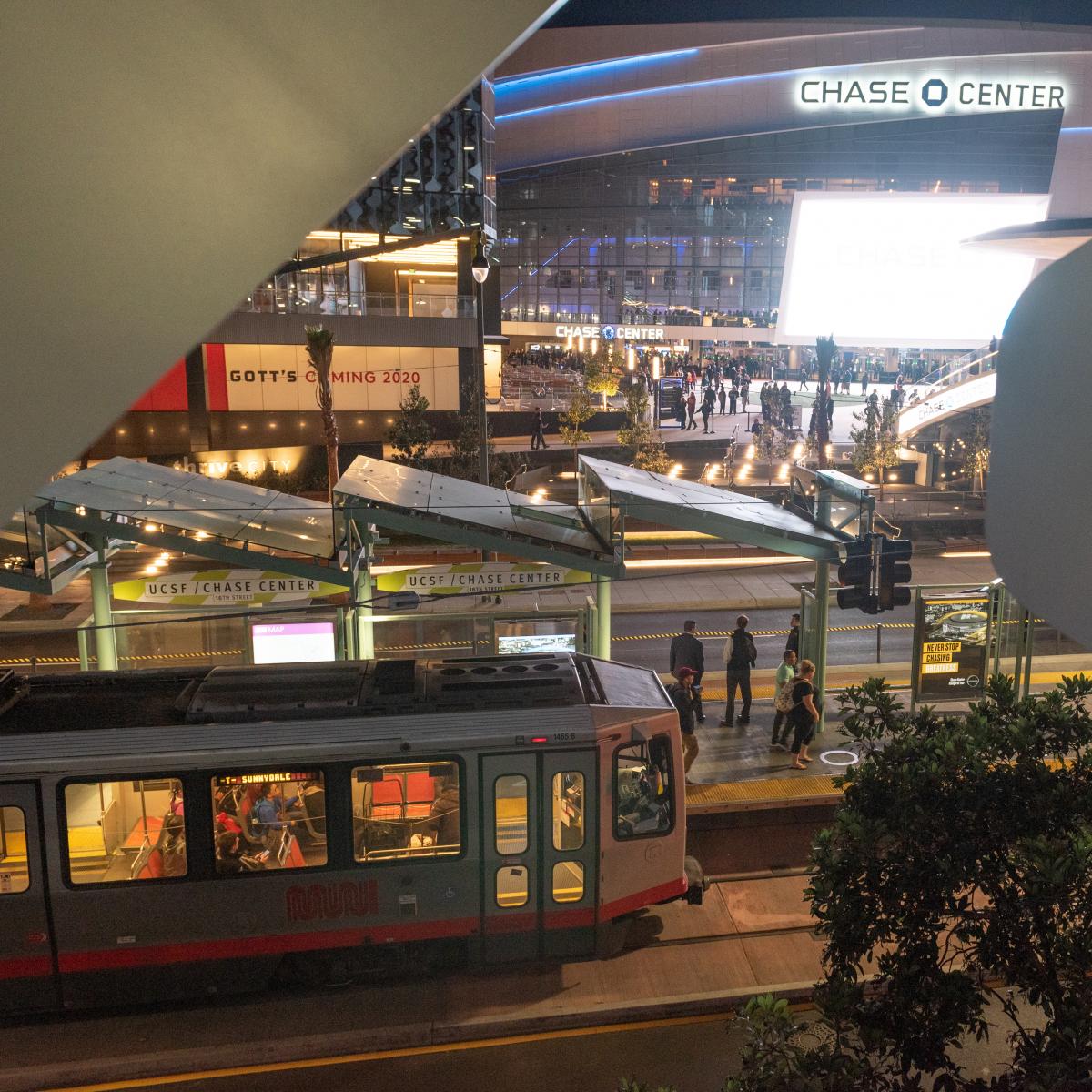
 Photo of a Muni Metro train at the UCSF/Chase Center platform with Chase Center in the background.

Starting January 7, take the S Shuttle Mission Bay on the new T Third line via Central Subway to Chase Center events.

Service on the new T Third Line from Chinatown Rose-Pak to Sunnydale starts January 7. With it, new event service to Chase Center will also start via Central Subway on the S Shuttle Mission Bay.

During events at Chase Center, shuttles will operate between Chinatown-Rose Pak Station and UCSF/Chase Center every 10 minutes. These shuttles will start approximately two and a half hours before an event and continue for two and half hours after an event.

From Chinatown to Chase Center, riding the S Shuttle Mission Bay takes about 20 minutes. Best of all, your Chase Center event ticket is your Muni fare. No additional Muni fare needed!

  • Both electronic and physical tickets for events – including Warriors games, concerts and other events – will serve as proof of payment for Muni service throughout the day.
  • The ticket will be valid all day and expire at the end of the service day at 2 a.m. after the event.
  • Passengers with a valid ticket can board through any door so we can quickly get you to the event or game! There is no need to show your Chase Center ticket to a bus or rail driver.
  • Keep your event ticket handy for proof of ticket purchase. To avoid fines, you will need to show your valid event ticket as proof of purchase if requested by a Transit Fare Inspector.

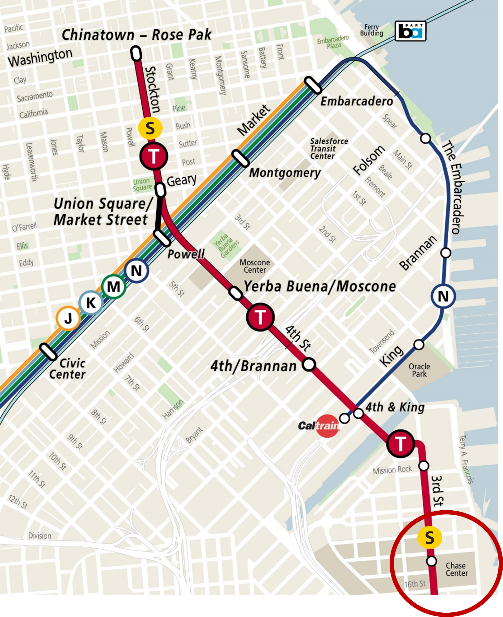
Map showing the new alignment of the T Third to Chinatown-Rose Pak Station, connecting from 4th and King streets and continuing north to Central Subway; existing Muni Metro system's J Church, K Ingleside and M Ocean terminating at Embarcadero Station; the N Judah continuing along the Embarcadero to Embarcadero & Folsom, Embarcadero & Brannan and 2nd & King and onto 4th & King; S Shuttle service between Chinatown and Chase Center.

The S Shuttle Mission Bay will operate between Chinatown-Rose Pak Station and UCSF/Chase Center during Chase Center events.

Muni Metro and BART customers can transfer at Powell Station underground to Union Square/Market Street Station and board the S Shuttle Mission Bay southbound to the UCSF/Chase Center Station. At Union Square/Market Street Station, elevators to the platform are in the center of the station with their own fare gates.

Customers traveling past Chase Center should board trains with head signs that say “T Third Sunnydale” to avoid transferring at Mission Bay.

The 78X 16th Street Arena Express will continue to run express service between Chase Center and the 16th Street BART station two and a half hours before events and one hour after events.

Visit our Chase Center webpage (SFMTA.com/ChaseCenter) for more information.


Published January 05, 2023 at 01:01AM
https://ift.tt/fLV6FY0

jeudi 10 novembre 2022

SFMTA Upgrades Predictions Software This Weekend!

SFMTA Upgrades Predictions Software This Weekend!
By Mariana Maguire

SFMTA will switch over to a new, upgraded software system on Sunday, November 13,  as part of our Next Generation Customer Information System (CIS) project. The new software was developed to improve the way our different information systems communicate with each other and share data to and from multiple sources. This will provide customers more accurate, timely, reliable Muni service predictions. This is one more important step in the overhaul of our CIS that will enable us to provide better service to Muni customers.

SFMTA’s Next Generation CIS software has been in preliminary testing for months, and if all works well, Muni customers should not notice any change. But anyone who’s had to help loved ones with computer or smartphone troubles knows that software updates aren’t always smooth. Unanticipated challenges may arise. Customers should expect some glitches as we make the software switch and work out issues on the back end.

To reduce impacts to customers, we are gradually connecting new screens to the new software system. This should help isolate any issues to troubleshoot more effectively. Our Customer Information System staff and software contractors will be keeping a close eye on system performance and working quickly to resolve issues.

This upgrade to a new, more efficient software system is a crucial milestone toward providing many new features over the coming months, including:

  • Dynamic maps
  • Real-time service changes
  • Short-term route changes
  • Terminal departure predictions
  • Transfer connection predictions
  • Regional connections
  • Alternative routes
  • Accessibility information
  • Vehicle crowding predictions

Third Party Apps

SFMTA provides open-source transit data that third party transit apps use on their platforms. Each app has its own way of processing that information, which can vary and may lead to differences or inconsistencies in transit information. SFMTA is in touch with known third party apps to help them troubleshoot issues.

We appreciate Muni riders’ patience as we continue our Next Generation CIS upgrades to improve Muni service long-term.

Learn more about what’s next for our Next Generation upgrades and the many new features rolling out soon.


Published November 10, 2022 at 10:59PM
https://ift.tt/YUE0LGe

mercredi 2 novembre 2022

Over Half Next Generation Muni Shelter Displays Installed with More Upgrades Coming

Over Half Next Generation Muni Shelter Displays Installed with More Upgrades Coming
By Kharima Mohamed

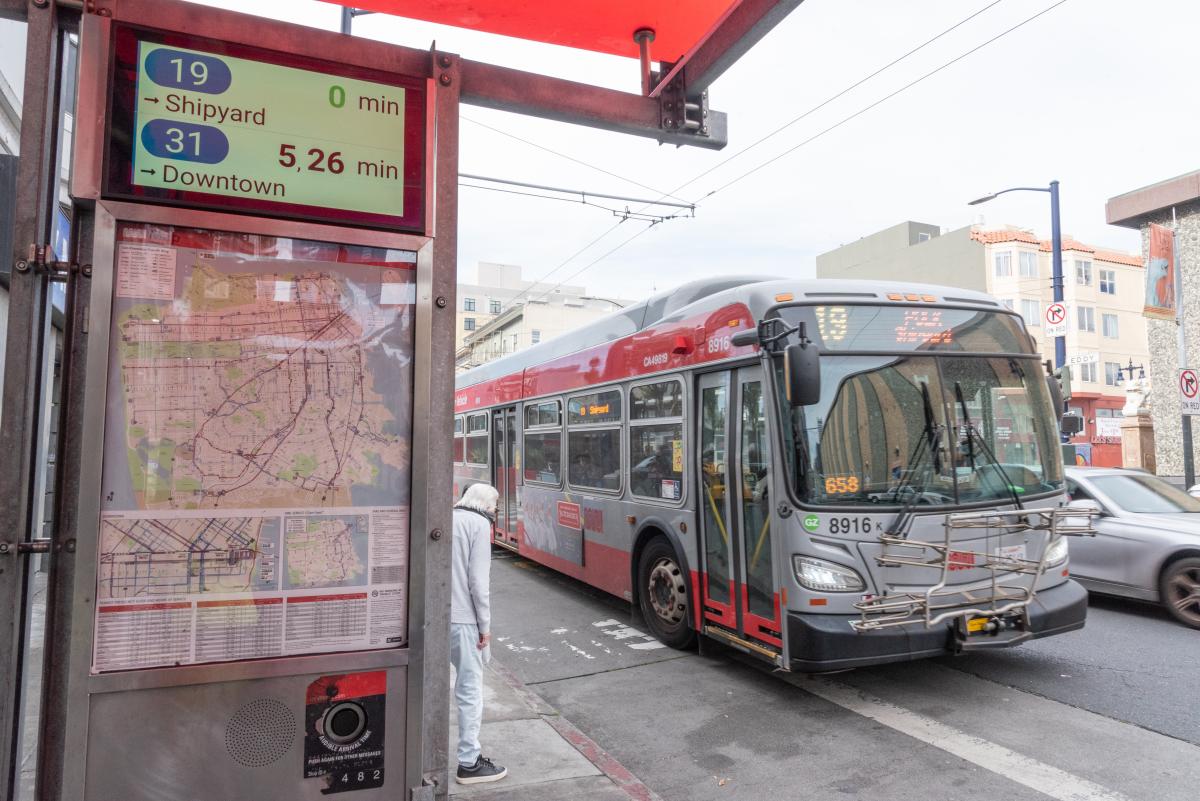
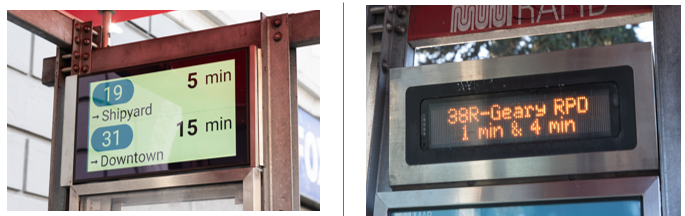
New Muni information screen at a bus shelter above Muni system map. New Muni service information displays are going into Muni shelters throughout San Francisco with updated features as part of SFMTA’s Next Generation Customer Information System upgrades.

As part of our Next Generation Customer Information System (CIS) project, we are installing over 800 new, larger Liquid Crystal Displays (LCDs) at Muni shelters and stations, replacing existing NextBus signs and expanding real-time information coverage. So far, we are over halfway to completion, with over 435 new displays installed in shelters. New screens show real-time multilingual information including graphics, maps and destinations.

Two displays being shown comparing the old versus new displays

New LCD displays (left) are replacing the previous Muni information displays (right).

Beginning this fall, Muni predictions on our new and improved Next Generation screens will include:

  • Crowding. On vehicles equipped with automatic passenger counters, displays will show how crowded they are.
  • Short-term route changes. We’ll be able to show planned short-term route changes, such as routing around special events. 

We are aiming to replace the remaining displays by the end of 2023. Additionally, we are working on new display locations with an emphasis on underserved neighborhoods, such as those identified by the Bayview Community Based Transportation Plan.

Learn more about the remaining display installation work, what’s next for our Next Generation upgrades and the many new features rolling out soon.

Get Real-Time Stop Information When Predictions Are Unavailable

Due to the nationwide AT&T 3G shutdown on June 8, NextMuni displays that use 3G modems no longer show information. We have been upgrading to 4G modems to continue to provide predictions while we roll out the new LCD display and prepare more significant system software upgrades.

For display locations remain impacted by the 3G shutdown, riders can obtain real-time stop information by using the stop ID number posted at the bus stop:

  • Online enter SFMTA.com/ followed by the stop ID number (no spaces). The stop at Market and 11th streets with stop ID 13245 can be found atSFMTA.com/13245
  • Text “NextMuni” and the stop ID number to 41411. For the stop at Market and 11th with stop ID 13245, send the text “NextMuni 13245” to 41411.
  • Call 511 and say “Departure Times” and the stop ID. For the stop at Market and 11th with stop ID 13245, say “Departure times 13245.”


Published November 02, 2022 at 10:51PM
https://ift.tt/ZWOCJMn

vendredi 28 octobre 2022

What’s new on the west side?

What’s new on the west side?
By Andrea Buffa

The west side of San Francisco is home to some of San Francisco’s most beloved recreational destinations — Golden Gate Park, the Presidio, Lake Merced, Fort Funston and Ocean Beach, among others. But many of these natural attractions — and others like Mt. Sutro and Twin Peaks — are also geographic barriers that can make travel to and from the west side of the city more difficult.

This may be one reason why three out of four people traveling within, to or from the west side do so by personal car. It’s also why we need to make sure there are more safe, reliable and affordable transportation options between west side neighborhoods and other citywide destinations.

This month we released an interactive website, San Francisco’s West Side on the Move, describing local experiences, transportation challenges and solutions in neighborhoods from the Richmond and the Sunset to Lake Merced, Parkside and West Portal. The website pulls together our latest efforts to make it safer and more convenient for people on the west side to get where they need to go. Our goal is for people who want to take Muni to have reliable and frequent service; for those who want to walk or bike to have safe streets; and for people who drive to face less congestion.

Beyond the geographic barriers that impede west side travel, other transportation challenges on the west side include street closures caused by construction projects and frequent closure of the Great Highway for sand removal. Street transformations that began during the pandemic, like Slow Streets and the closure of some roads in Golden Gate Park to cars, also altered some residents' trip patterns. We've been listening to and collaborating with community members on the west side about how to better address these challenges and meet their needs as well.

San Francisco’s West Side on the Move describes the solutions we’ve implemented or plan to implement soon on the west side. Our Transit team has already made major strides in improving west side Muni lines like the 38 Geary and 5R Fulton Rapid using tools like red transit lanes, bus bulbs and smart traffic signals. Travel times on the 38 Geary are up to 20% faster than they were previously, and travel times on the 5R Fulton Rapid are up to 12% faster. We’ve also improved travel times on the 1 California and the N Judah.

While the L Taraval Improvement Project is still in construction, it has already delivered important safety benefits. On the completed section of the L Taraval, which finished on time and on budget, pedestrian injuries decreased by 60%. Improvements like this are vitally important in all San Francisco communities, and especially so in this part of the city which is home to so many older adults and families with small children.

When it comes to reducing congestion, we are adjusting signal timing to keep up with changing traffic patterns, adding turn lanes and restrictions in key locations and providing more loading zones in commercial areas to reduce double-parking. We also monitor the network for opportunities to improve bottlenecks, such as the recently re-opened MLK Drive between Chain of Lakes Drive and Sunset Boulevard.

To slow down traffic on residential streets and make walking and bicycling safer and more enjoyable, we’re using traffic calming tools like speed bumps to slow vehicle speeds. In 2021, the SFTMTA invested in a comprehensive package of traffic calming measures in the Outer Sunset to address local concerns. Monitoring indicates that traffic speed and volume was reduced, which ideally creates safer conditions for all road users.

While the Slow Streets program has provided valuable, safe routes for people who walk, bike and roll, we've heard from residents that they're not working well for every community, particularly the Sunset. There, the Sunset Neighborways program is replacing Slow Streets to create a network of safe streets for active transportation. The emphasis of Sunset Neighborways will be on slowing down traffic to improve safety, rather than restricting it. In the Richmond, Anza Street is a key corridor for biking and active transportation, and in response to community requests for a better east-west bike route through the neighborhood, we added bike lanes and safety improvements like speed cushions to slow traffic and create a street that can be easily and safely shared by cyclists and drivers. 

By releasing San Francisco’s West Side on the Move, the SFMTA hopes to deepen its dialogue with west side community members about what’s working well and what can be improved when it comes to keeping the west side moving. Please share your ideas by emailing WestsideProjects@SFMTA.com

Should we say how important the decrease in pedestrian injuries is so significant given how many seniors and families with small kids live in the area?


Published October 28, 2022 at 11:19PM
https://ift.tt/hOBASdu

jeudi 6 octobre 2022

What’s in Proposition L?

What’s in Proposition L?
By Andrea Buffa

On November 8, San Francisco voters will decide whether to continue a half-cent transportation sales tax that has been funding city and county transportation projects since it was first enacted in 1989. Proposition L is not a tax increase but does require a two-thirds majority vote to pass.

The half-cent sales tax is administered by the San Francisco County Transportation Authority (SFCTA).  Proposition L would approve a new 2022 Transportation Expenditure Plan for how these funds will be spent for the next 30 years.

The 2022 Transportation Expenditure Plan will fund projects in these categories:

  • 41% for transit maintenance and enhancements: Funds Muni, BART, Caltrain and ferries. The money goes toward maintenance, rehabilitation and replacement of vehicles; station and access improvements; and planning for the next generation of public transit.
    • Examples: New buses and light rail vehicles, electrifying Muni’s bus fleet, maintaining buses and trains so they operate safely and reliably
  • 23% for major transit projects: Funds Muni bus and train reliability and efficiency improvements; increasing Muni and BART capacity; and major expansion projects
    • Example: The Caltrain Downtown Extension from 4th and King railyard to the Salesforce Transit Center
  • 19% for streets and freeways: Funds street repaving; walking and bicycling safety improvements; signals and traffic calming; and major street and freeway redesign planning
    • Examples: Neighborhood-level investments such as crosswalks, traffic calming, new and upgraded traffic signals, bicycle lanes and Safe Routes to School programs
  • 11% for paratransit: Funds the SFMTA’s paratransit service, which is a van and taxi program for people who are unable to independently use or access public transit because of a disability or disabling health condition
  • 6% for system planning and community equity: Funds transportation demand management; neighborhood and equity-focused planning and implementation
    • Example: Implementing improvements identified in community-based plans across the city and particularly in Equity Priority Communities

The SFCTA website provides more details on the 2022 Transportation Expenditure Plan.

In previous years, the sales tax has funded projects large and small, some of the well-known ones being the Salesforce Transit Center, the electrification of Caltrain (anticipated to be done in 2024), Muni Central Subway and reconstructing Doyle Drive, now known as Presidio Parkway.

It has also funded smaller projects like traffic calming, street repaving, protected bike lanes, new and upgraded signals and, during the pandemic, taxi rides home for essential workers.

To compete for federal and state grants, such as the funds in last year’s federal Bipartisan Infrastructure Law, San Francisco needs local funds that match the money from the grant. The sales tax funds are our main source of these matching funds. On average, we’ve leveraged every dollar in half-cent sales tax funding to attract $4 - 7 in additional funding from federal, state or other sources.

If Measure L does not pass, the half-cent transportation sales tax will continue to be collected until March 2034. However, the money can only be spent on projects that were included in the Transportation Expenditure Plan from 2003.

To learn more about the half-cent transportation sales tax, you can go to the SFCTA website.


Published October 06, 2022 at 10:32PM
https://ift.tt/eYnMKBx

jeudi 28 avril 2022

Bikeshare Pricing Frequently Asked Questions (FAQ)

Bikeshare Pricing Frequently Asked Questions (FAQ)
By Adrian Leung
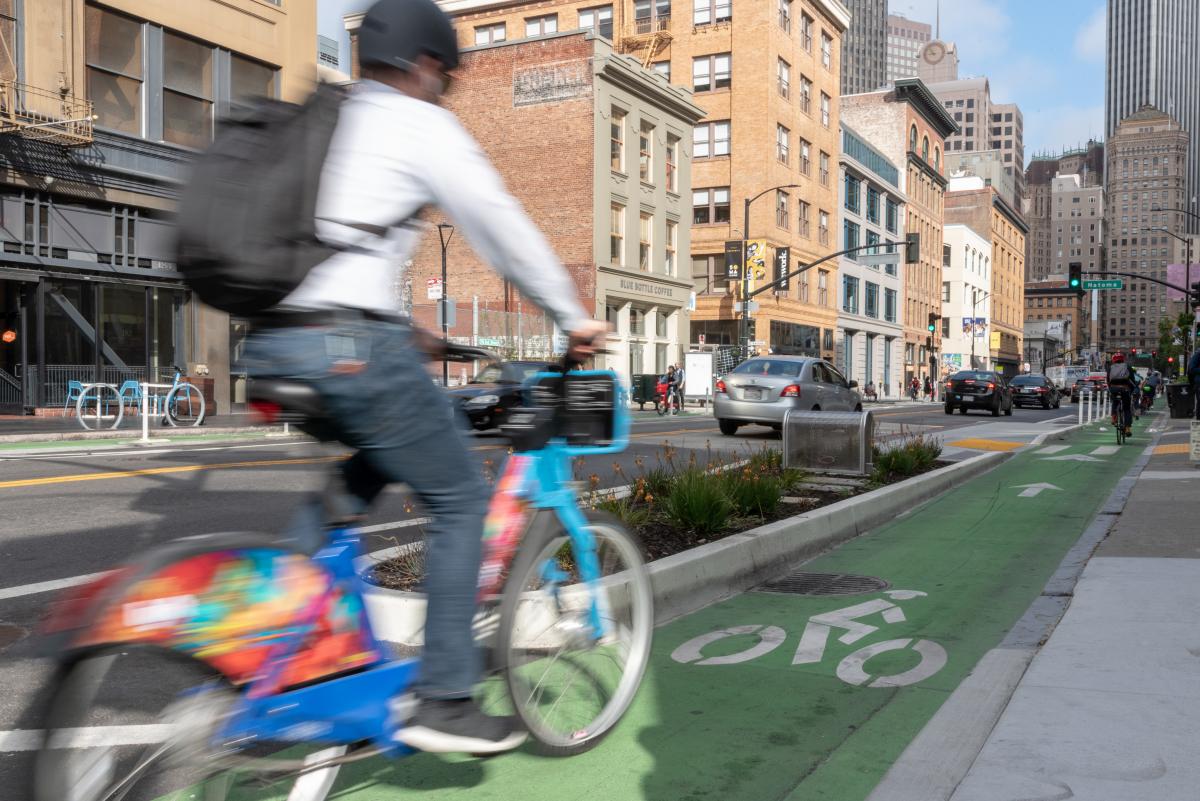
Image of a bikeshare rider using a designated bike lane on city streets

With Spring in the air and a recent expansion of up to 275 stations in SF, more people are riding bikeshare. Our major goal is to make bicycling easy by making bikes available while simultaneously reducing the burden of ownership (e.g. theft, storage, maintenance).  We’ll see discount codes for new members in Bike Month May. And Lyft is providing ride credit for anyone riding a regular pedal bike in the last 30-days, who’ve never tried the e-Bikes. 

We get a lot of questions about pricing—How does pricing work? Who sets it? Is this Private or Public? We figured a dedicated FAQ could help to cover the basics. 
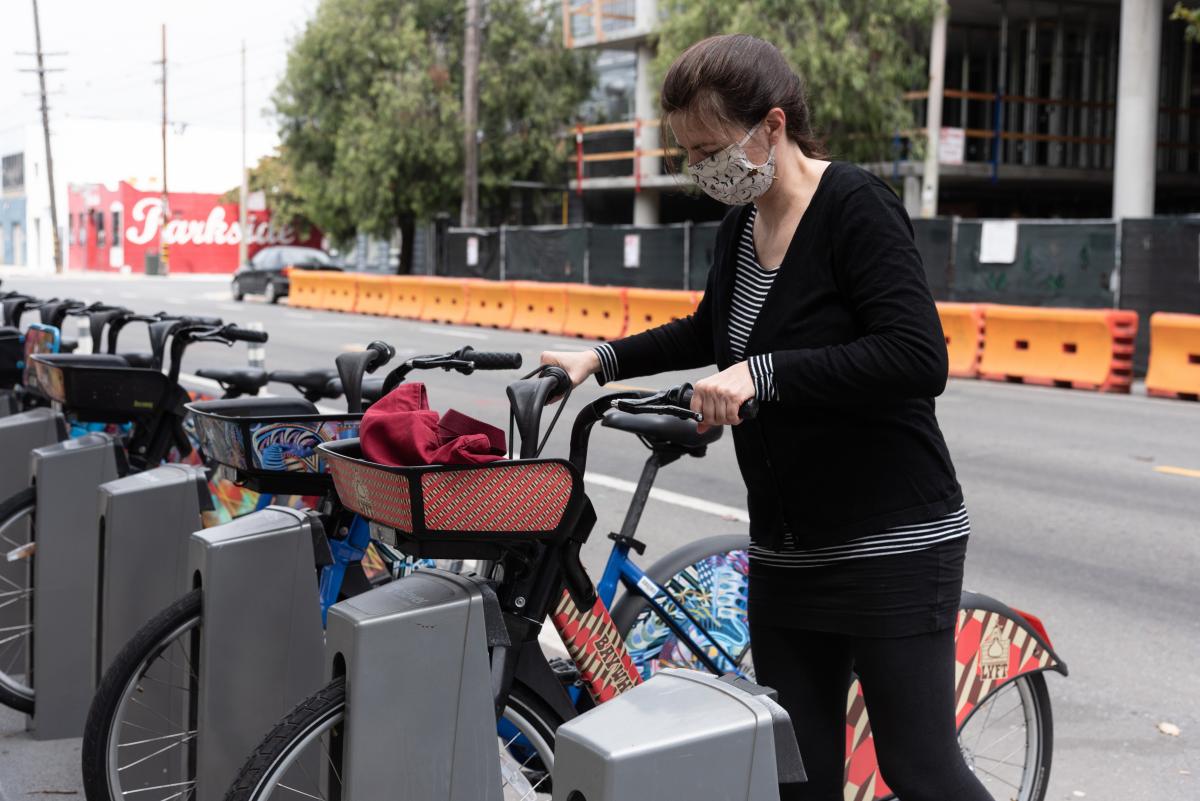
Photo showing an e-bike user undocking an e-bike

How much does bikeshare cost?

Bikeshare is the most affordable mobility option in San Francisco and the Bay Area. An annual bikeshare membership costs about $14/month, which includes unlimited 45-minute trips on regular pedal bikes with no additional fees anywhere in the five-city service area.  

Why do e-bikes cost more? 

E-bikes contain batteries that need charging and more expensive parts like motors and sensors that require more maintenance and more work to locate and redistribute. The city and our bikeshare operator, Lyft, try to balance these costs with maintaining and improving service for all San Franciscans, especially ones who can't afford higher prices.  

The 2015 bikeshare agreement grants exclusivity to the contractor for station-based bikeshare. In 2019, the SFMTA sought to offer e-bikeshare operator permits to increase competition. An ensuing lawsuit resulted in Bay Wheels exclusivity and SFMTA approval power over pricing while allowing the operator to push towards financially sustainability.  

How is pricing decided? 

The annual membership pricing was specified by the 2015 regional agreement, managed by Metropolitan Transportation Commission and unanimously approved by SF Supervisors. E-bike per minute pricing is subject to SFMTA approval (keeping increased operating costs and program financial sustainability in mind), and all other pricing, like per-trip unlock fees and overages, is up to Lyft. 

How has the city used pricing approval power to expand equity measures for bikeshare? 

The city can’t lower e-Bike prices, but it has negotiated public benefits like  
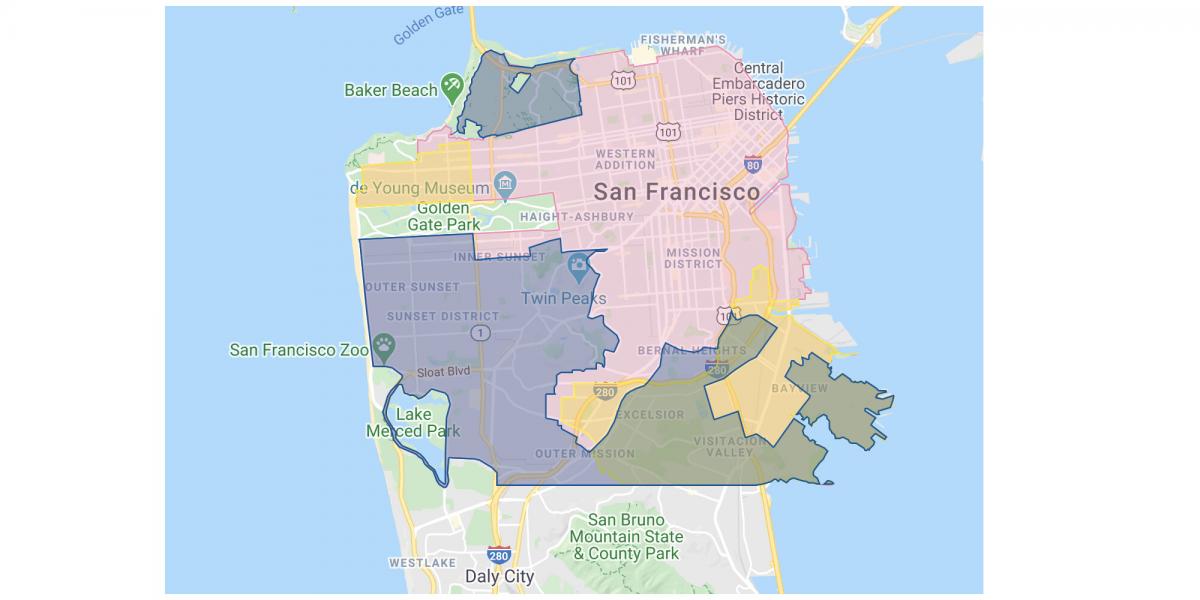
City map showing Bay Wheel service area

Why is there a 45-minute time limit?  

Bikeshare is designed for shorter duration trips. The system works by circulating—sharing—bikes between users. When a bike is checked out, it reduces the number of total available bikes in the system and increases the possibility there won’t be enough bikes for people who need them and this hurts system dependability. If a rider needs a bike for longer than 45 minutes, they can always check out a new bike mid-trip to complete their ride. For longer trips, the city recommends looking into other non-bikeshare options, like bike rentals.    

What are the costs associated with bikeshare, and who pays for them? As a public private partnership, all expenses—including labor and maintenance--are paid by the operator, and San Francisco and its regional partners offer this service at no cost to taxpayers. Bikeshare provides living wage union jobs to station technicians, bicycle mechanics, and system rebalancers, and city planners and engineers support the research, expansion, communications, and customer service needs for the program.
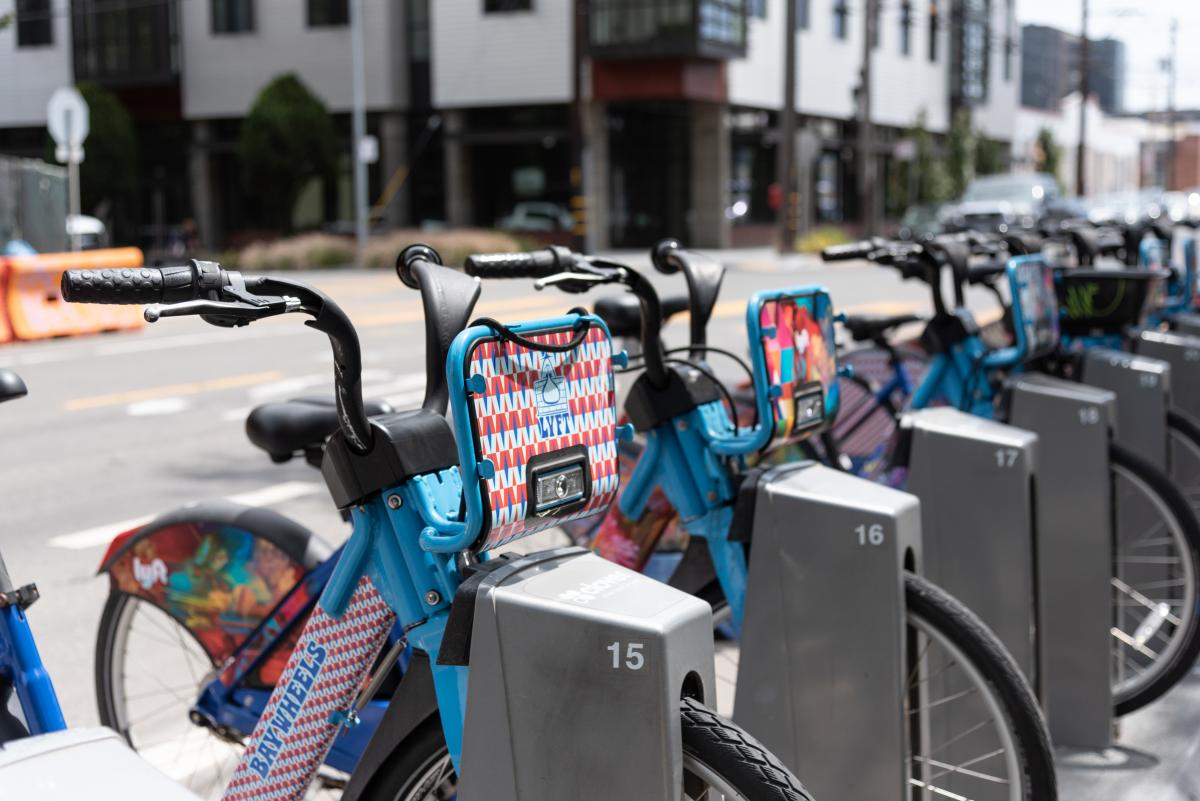
  Photo showing e bikes lined up at a docking station

What’s next for pricing?  

The current e-bike agreement ends in 2024; the regional regular pedal station-based contract ends in 2027. The city and regional partners are exploring services, pricing, and partnerships that may come next, with the goal of continuing to expand bikeshare as an accessible, sustainable transportation choice for San Francisco.  

If you have thoughts on bikeshare pricing, we want to hear from you. Feel free to reach out with ideas to bikeshare@sfmta.com. 

And to celebrate National Bike Month, starting May 1, Bay Wheels is providing 20% off annual or monthly Bay Wheels membership. Enter one of the codes below at checkout and enjoy membership benefits for less. 
 
20% off Annual Memberships: BWMAYANNUAL20 
20% off Monthly Memberships: BWMAYMONTHLY20 


Published April 28, 2022 at 09:50PM
https://ift.tt/t1VB5iP
mardi 26 avril 2022

SFMTA Announces New Initiative to Address Safety

SFMTA Announces New Initiative to Address Safety
By Kimberly Burrus

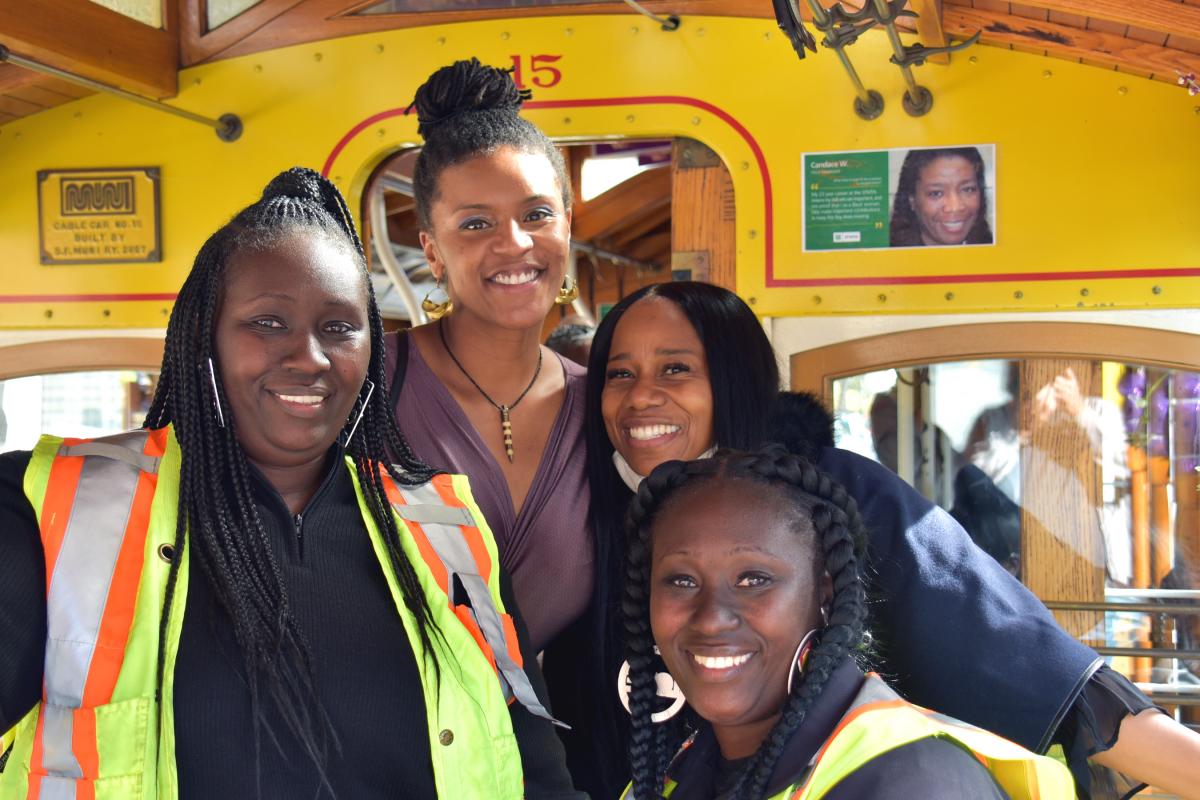
Photo of four African American female SFMTA staff

SFMTA staff celebrating women’s history

Safety is an absolute priority for the SFMTA. We’ve heard loud and clear that personal safety is a growing concern for the public and staff and we’ve taken a lot of steps to increase safety across our system. We also know there is much work to do to address some of the most pervasive ways harassment and violence show up in public transportation.  

This April as we observe Sexual Harassment Awareness Month, the SFMTA is proud to announce that we are developing a new Safety Equity Initiative. The goal of the initiative is to reduce and eventually eliminate gender-based harassment and violence on Muni. 

Gender-based harassment is one of the most widespread and persistent forms of violence. It impacts women, girls and gender-expansive people — people who don’t conform to traditional gender roles — of all ages, abilities, races, ethnicities, and cultural and language groups. Women often feel unsafe on transit, which impacts how often they ride, when they ride and if they ride at all. This is especially true for women and girls of color, and gender-based harassment disproportionately impacts community members who are Black, Indigenous and people of color (BIPOC).  

The Safety Equity Initiative will center the experiences of our most transit-reliant community members and build community-focused solutions. Our initial steps will focus on understanding the scope and gravity of the issues through data collection and outreach. We will partner with community-based organizations, our riders and staff to enhance our existing reporting structure and implement data-driven security upgrades.  

New Reporting Options 

We know gender-based harassment often goes unreported. There is much we need to learn to make meaningful progress and we need your help. That’s why we are expanding reporting options on our Muni Feedback form and the 311 Customer Service phone line.  

In the coming days, users and bystanders will be able to report different types of gender-based harassment incidents, their location and other information that will help us understand the scope of the problem better, identify possible improvements and track progress. 

These incidents can include inappropriate, unwanted contact, gestures or comments, staring, groping, indecent exposure, abuse and violence of a sexual or nonsexual nature. Some of these incidents may also be criminal acts. All of them are unacceptable, and we have a duty to work to end these behaviors. 

Why We Are Focusing on Gender and Racial Equity 

Gender-based harassment doesn’t happen in a vacuum. It’s often targeted at BIPOC and low-income women and can be laced with racism. LGBTQIA people are also frequently subjected to gender-based harassment that is laced with homophobia and transphobia. At the same time, people who belong to groups with less power and resources in society tend to be less likely to report it to when they’re harassed.  

By elevating equity as a key part of this safety initiative, we want to signal that we’re seeking engagement and partnership from all the diverse groups of people who are impacted by gender-based harassment. This includes trans women and girls, non-binary people, gender non-conforming people, gender queer people, cis girls and cis women and any woman- and girl-identified individuals. We will also work to educate and engage men and boys to help prevent harassment. 

Our staff were inspired by BART’s Not One More Girl campaign, which has been a model for building partnerships and community-driven solutions around gender-based safety challenges. Similarly, we want to collaborate with a diversity of stakeholders, community-based organizations and community members to develop community-centered solutions that make our transportation system safer for all – staff, riders and bystanders. 

We’re excited to embark on this process and look forward to creating change together.  

Read more about our program vision, goals, intended outcomes and commitment to the community on the new project page at Safety Equity Initiative.. Email us about this initiative, and other safety issues, at MuniSafe@SFMTA.com.  


Published April 26, 2022 at 11:10PM
https://ift.tt/XVwex8g

mercredi 30 mars 2022

Women Pioneers at Muni: Adeline Svendsen and Muni’s First Newsletter

Women Pioneers at Muni: Adeline Svendsen and Muni’s First Newsletter
By Jeremy Menzies

To close out Women’s History Month, here’s a look back at one woman whose work to bring Muni staff together in the late 1940s created a legacy that lives on to this day. Adeline “Addy” Svendsen was founding editor of Muni’s first internal newsletter, “Trolley Topics.”

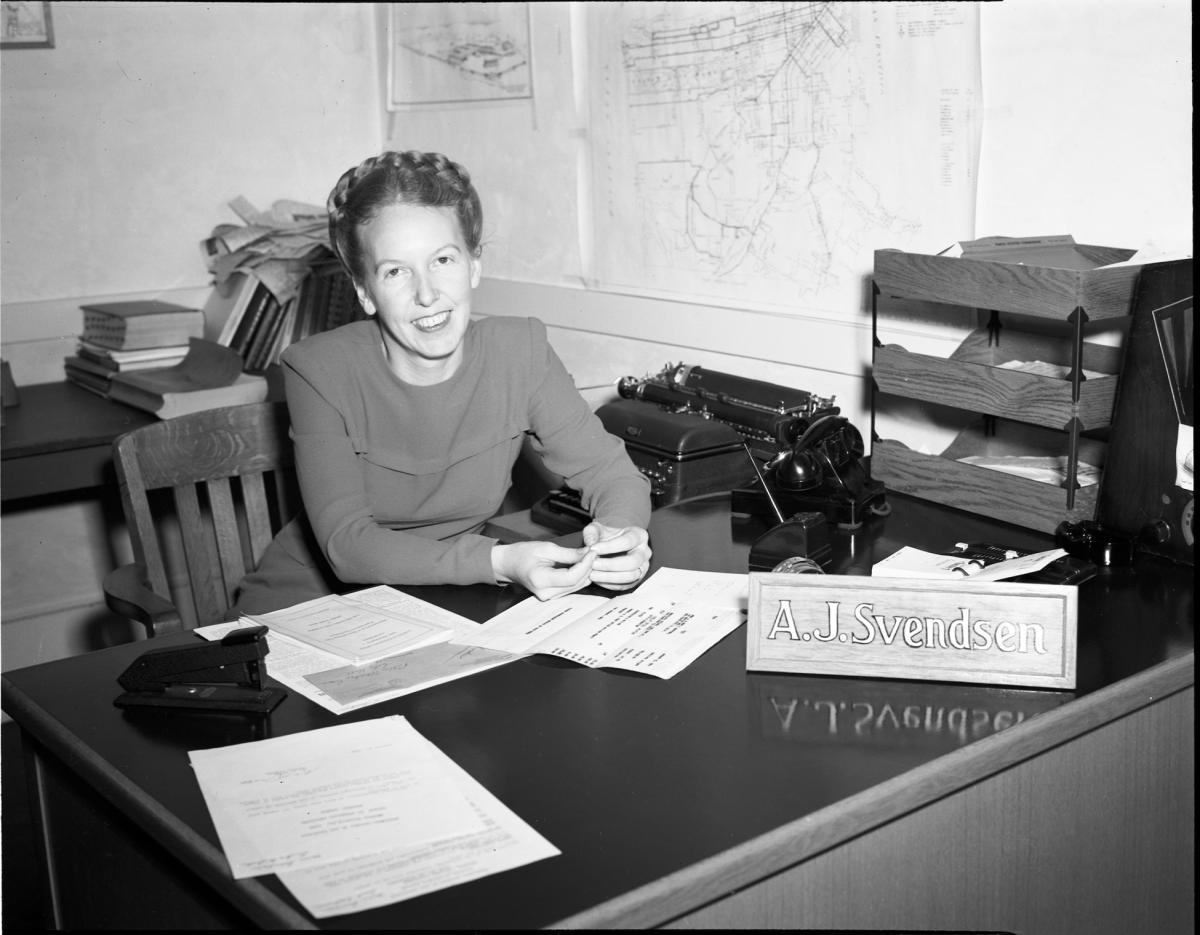
Adeline Svendsen sits at her desk in the Geneva Carhouse office building in this 1949 shot.

Adeline Svendsen sits at her desk in the Geneva Carhouse office building in this 1949 shot.

Trolley Topics was a new venture when it started in February 1946. As Svendsen wrote in the first issue it was created, “to bring a little fun, a little news, and a lot of good will to all our fellow employees in the Railway.”

Just two years prior in 1944, Muni merged with the Market Street Railway Company, expanding the small municipal operation into the largest transit provider in the city with hundreds of employees, vehicles of every shape and size, and dozens of facilities scattered across town. The newsletter was meant to help unite the two workforces (which historically had been in competition with each other) and keep everyone on the same page about what was happening across the railway.

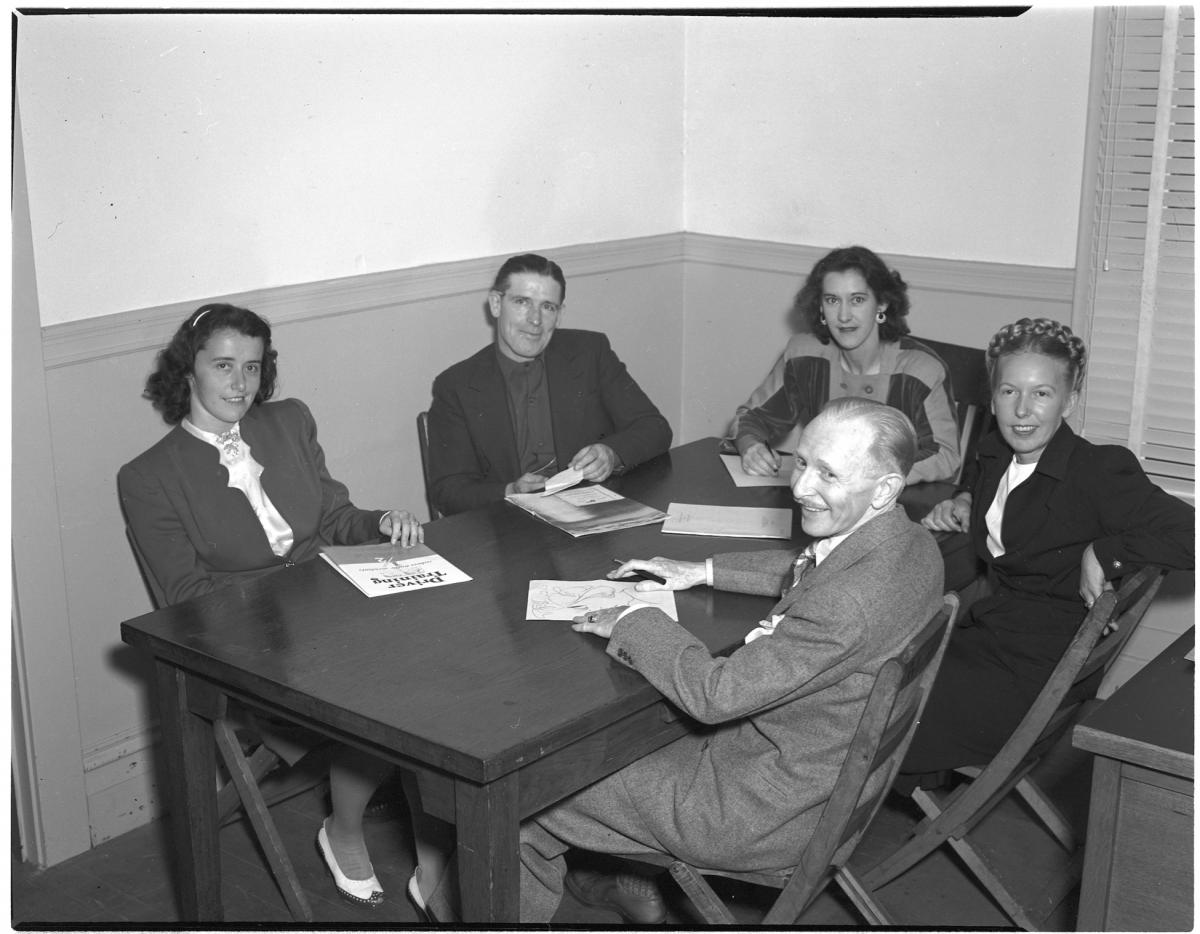
Group photo of Trolley Topics contributing staff in 1946. Clockwise from left: reporters Dolores Shea, Robert Fish, Maybelle Paetzel, editor Adeline Svendsen, and cartoonist Charles Reed.

Group photo of Trolley Topics contributing staff in 1946. Clockwise from left: reporters Dolores Shea, Robert Fish, Maybelle Paetzel, editor Adeline Svendsen, and cartoonist Charles Reed.

Through her perseverance and editorial savvy, Svendsen’s monthly quickly evolved from a bare-bones typewritten handout to a proper paper within just six-months of the first issue. Properly printed with an eye-catching front page, nicely laid out columns and photographs supplied mainly by the Muni Photography Department, Trolley Topics looked much like any professional magazine of the day.

Typically, each issue had sections for employee commendations, news from each division about staff activities, goofy transportation-centric cartoons, and articles about general railway announcements and programs. As the years progressed, the paper expanded its scope to include messages from the mayor, announcements about policy changes affecting city employees, more photos from staff events and awards, and occasional news from other departments.

Svendsen poses with one of Muni’s newest buses in this 1947 photo taken at a bus garage once located on 24th and Utah streets.

Svendsen poses with one of Muni’s newest buses in this 1947 photo taken at a bus garage once located on 24th and Utah streets. 

Unfortunately, Adeline Svendsen left the Railway abruptly in 1952 and with her departure, the publication ceased production. Despite the short-lived run of the paper, Svendsen’s nearly seven-year project left an important mark on Muni.

Recognizing the importance of Svendsen’s original Trolley Topics, the newsletter was revived using the same name in 1973. Much like its predecessor, the 1970s Trolley Topics covered staff awards and events but also focused on major programs to improve the system. In mid-1980, the second run of the paper ceased production due to budget problems, with no replacement until the 1990s.

Not only did Adeline Svendsen’s Trolley Topics bring staff together and provide much needed information at the time it was published, her work offers inspiration for our ever expanding efforts to connect our nearly 6,000 colleagues today. Additionally, the stories and photos published in both the original and the revived Trolley Topics give us an invaluable glimpse into the operations and culture of Muni during those times.


Published March 30, 2022 at 11:11PM
https://ift.tt/rvyFWNU

vendredi 25 février 2022

Improved Muni Transit Information

Improved Muni Transit Information
By Kharima Mohamed

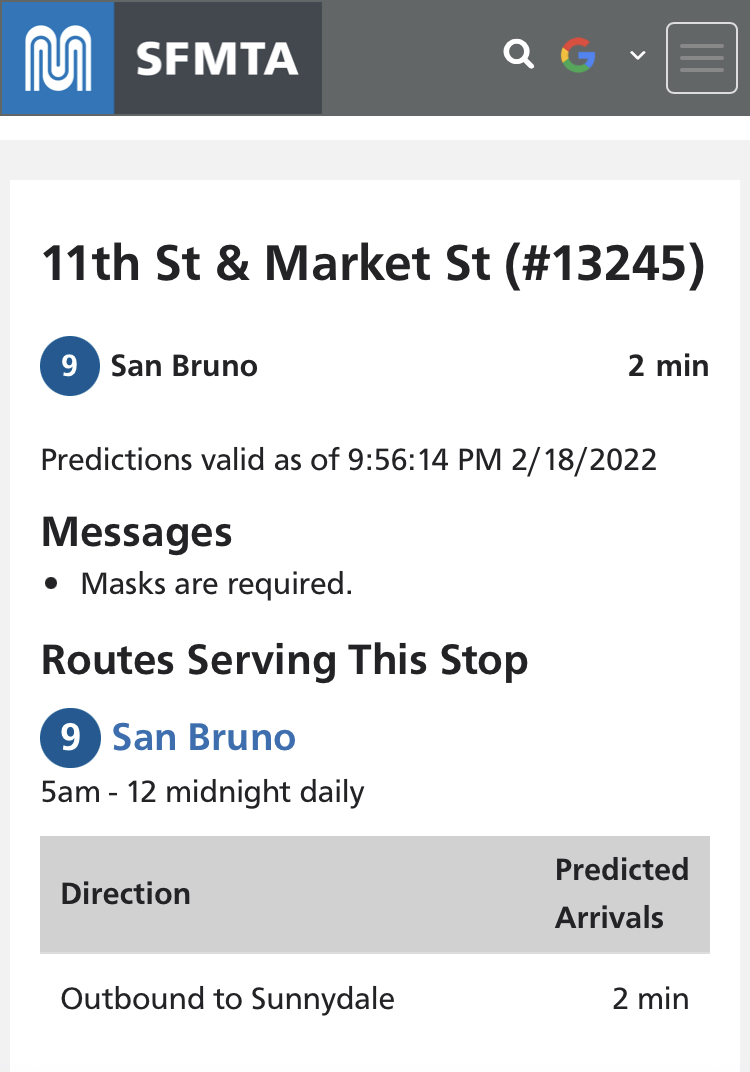
As part of the larger effort to provide improved transit information to Muni riders, we have significantly improved the SFMTA.com stop webpages with a focus on improved accessibility. 

Each of the over six thousand stops throughout the Muni Service Network has a unique webpage that displays multiple features. These improved features on the stop webpage help to improve the customer experience for riders to easily get all the information they need to get where they need to be.  

Features include: 

  • A mobile-first designed web app view for succinct on-the-go real-time vehicle predictions at the top of the page. 

  • Detailed route information served at each location. 

  • Alerts specific to both that specific stop and all of the routes served. 

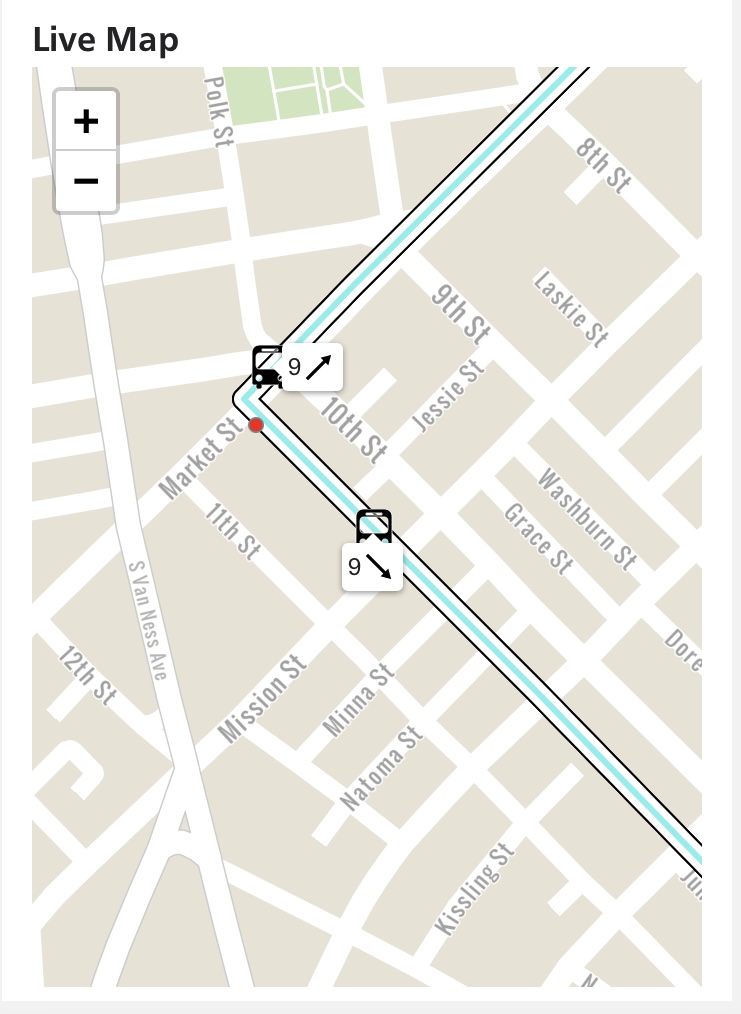
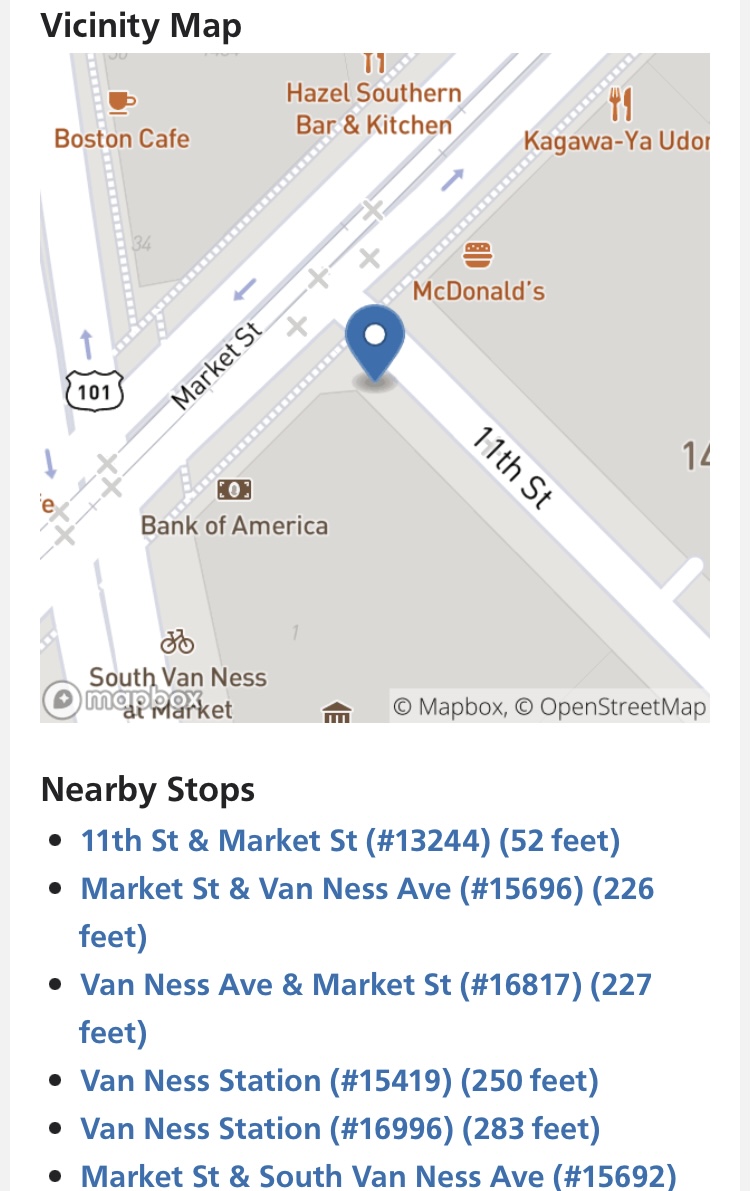
  • A real-time vehicle-tracking map and a vicinity map for each stop. 

  • Nearby stops to provide stop options if an alternative is needed. 

To visit the new stop page of your choice, simply use its five digit stop ID. You can find the five digit stop ID at the top of the transit shelter. For example, the stop ID at 11th St and Market is 13425, the short URL is SFMTA.com/13425

Example image of a stop page using the transit shelter's five digit stop ID

Included in this release are enhanced accessibility features that allow screen readers to not only read the details of the stop’s service, but also display when a vehicle approaches to ensure that nobody misses their ride or gets on the wrong vehicle. 

Live map image showing the real time approach of a vehicle's arrival to ensure that nobody misses their ride or gets on the wrong vehicle.

Part of this update is an all-purpose “Find a Stop” page that supports geolocation, lookup stops or map interface to find any stop throughout the Muni Service Network. With a location services enabled on a customer’s smartphone this webpage returns to the nearest stops. The webpage also includes a lookup for address, intersection, and places of interest as well as a map interface for riders that do not wish to use geolocation. All the features on the stop webpage presents riders with multiple options to choose from to plan their Muni ride and continue their trip journey. 

Image showing nearby stops using geolocation services.

These enhancements are part of the Next Generation Customer Information System Project. Future improvements will soon include an improved multimodal trip planner, more accurate predictions and enhanced accessibility information for each stop that will enable improved accessible trip planning. 

As AT&T’s 3G decommissioning impacts NextMuni electronic displays*, the SFMTA.com stop webpages and third party transit information applications are easy-to-use options to get vehicle predictions and other much needed transit information so that you can plan your trip efficiently. *We anticipate a gradual wind down of the AT&T 3G service over the next few weeks. Our NextBus signs are currently operational, but this will likely change in phases.


Published February 25, 2022 at 10:51PM
https://ift.tt/TnaQMxg

mercredi 9 février 2022

POTUS Appoints SFMTA Planner to U.S. Access Board

POTUS Appoints SFMTA Planner to U.S. Access Board
By Stephen Chun

Maddy Ruvolo, Streets Accessibility Planner in the Taxi, Access and Mobility (TAMS) Division

A big shout out to Maddy Ruvolo, Streets Accessibility Planner in the Taxi, Access and Mobility (TAMS) Division! 

On Monday, the President of the United States announced his intent to appoint our very own Maddy Ruvolo to serve on the U.S. Access Board as an Architectural and Transportation Barriers Compliance Access Board Member. The U.S. Access Board is an independent federal agency that promotes equality for people with disabilities through leadership in accessible design and the development of accessibility guidelines and standards. This role is a very important, critical and prestigious position and it is no secret that Maddy Ruvolo is the perfect individual to serve on the U.S. Access Board and represent San Francisco.  

Ruvolo has been widely recognized for her commitment in the accessibility of transportation for persons with disabilities. At the SFMTA, she has been instrumental in the agency’s efforts to ensure the accessibility of emerging and active mobility modes in scooter and bicycle programs, and Transporation Network Companies (TNC).   

Ruvolo also played a key role in the implementation of accessibility guidelines for Shared Spaces, where business owners are required to comply with the Americans with Disabilities Act (ADA) for their parklets and/or outdoor (dining) spaces. Her work also involves conducting engaging and effective public outreach, including soliciting meaningful input from people with disabilities and older adults on pivotal decisions about mobility in Golden Gate Park. 

Maddy Ruvolo leading an Accessibility Tour for the Golden Gate Park Access & Safety Program in 2021

Ruvolo will be staunchly representing San Francisco and advocating for persons with disabilities in the transportation sector.  She has a master's degree in Urban and Regional Planning from UCLA, a Bachelor of Arts in American Studies from Scripps College, where she graduated summa cum laude, and she has worked for the UCLA Institute of Transportation Studies, the Los Angeles Department of Transportation, and the Oakland Department of Transportation. Ruvolo has received many accolades for her past accomplishments such as the Dwight David Eisenhower Transportation Fellowship and Myra L. Frank Memorial Graduate Scholarship. And of course, we recognize her experience here at the SFMTA as a San Francisco Fellow in Livable Streets, an analyst on the Performance Team, and now as a transportation accessibility planning expert.   

Please join us in congratulating Maddy Ruvolo! Many across the country will now benefit from her commitment to equal access and direct engagement. For more information, please visit U.S. Access Board or President Biden Announces Key Appointees. 


Published February 09, 2022 at 10:59PM
https://ift.tt/Mm45sfr

vendredi 7 janvier 2022

Omicron Surge Impact on Muni Routes and Schedules

Omicron Surge Impact on Muni Routes and Schedules
By Julie Kirschbaum

Photo of a bus operator wearing a mask

As has been reported widely in the media, the highly contagious Omicron variant has led to rapid and unprecedented spread of the COVID-19 virus in San Francisco. More than 100 SFMTA staff have contracted COVID since late last month. Combined with pre-existing staffing shortages, this has led to an increase in missed Muni service. We’re also experiencing staffing impacts in other job classifications, including mechanics, car cleaners and transit supervisors. 

Currently, we are missing up to 15% of scheduled Muni service, which means that riders may need to wait longer than usual for their bus or train. Our hope is that this will be the extent of our impacts. However, the situation is fluid, and we are monitoring staffing levels on a daily basis.

As part of our contingency planning, we are preparing for what might happen if our overall staffing levels drop significantly or if a small, but vital group—such as our Transit Management Center or Power Control Center is significantly impacted. Either of these situations could leave us with no choice but to make additional Muni service reductions such as cancelling routes or introducing bus substitutions for rail service.

We are doing our best to avoid this situation by communicating proactively with staff about masking and staying home if they have any symptoms and keeping some staff working vital functions at remote locations to limit exposure. We are grateful that nearly 100% of the SFMTA workforce is vaccinated, and we are encouraging boosters as an effective precaution. We are also doing hard work behind the scenes to prepare signage, operator instructions, and all the other materials we would need to implement changes as smoothly as possible — in the case these become necessary.

For the latest information on service changes, please visit our Core Service webpage. You can also find our latest updates by subscribing to Muni alerts or visiting our Twitter feed.


Published January 07, 2022 at 11:10PM
https://ift.tt/3G9cRbZ

jeudi 12 août 2021

Changes Coming to NextMuni

Changes Coming to NextMuni
By Mariana Maguire

Muni display showing 38 Geary arrivals

When the SFMTA first partnered with NextBus more than twenty years ago to create NextMuni, the real-time transit vehicle arrival predictions system was state-of-the-art and revolutionary for its time. As technology has advanced and our transit system has grown, we are moving to a new system that will best meet the needs of our customers.

Last year, the SFMTA Board of Directors and the Board of Supervisors approved a contract for the Next Generation Customer Information System to replace NextMuni.  Set to debut in 2022, the new Customer Information System will focus on improving predictions accuracy, particularly near the beginning of routes, along with several other customer-friendly upgrades. New, larger graphical signs in transit shelters will also feature maps showing the real-time positions of vehicles. These enhancements will help improve the customer experience and make riding transit easier.

While the SFMTA has been working on the Customer Information System initiative, we are still providing customers with the best information possible within the existing NextMuni system's technical limitations.  This week, we've made some interim upgrades that will make it easier for customers to navigate around the system and learn about the August 14 service changes. 

New NextMuni Improvements

We have optimized NextMuni for the SFMTA website, which means some new conveniences for customers navigating Muni, and important, customer-tested accessibility features:

  • Customers can now stay on the SFMTA website for NextMuni predictions
  • Arrival predictions are integrated with stop information rather than being in two different places
  • For Muni stop information and self-updating predictions, typing SFMTA.com/ followed by the 5-or-6-digit Muni stop ID number takes customers directly to the Muni stop web page with details
  • Muni stop pages provide both a vehicle-tracking map and a vicinity map integrated with the predictions and stop information
  • Muni stop pages link to nearby transit stops so customers can consider alternative routes

What to Expect During August 14 Service Changes

Whenever the SFMTA implements a large service change, we usually receive many questions about NextMuni. In fact, you may see some lag in NextMuni updates when our next round of service changes goes into effect on August 14.  To help explain, here are some answers to frequently asked questions:

Why are predictions sometimes inaccurate after a service change?

For new and restored routes, it usually takes a few days after the service starts for accurate arrival time predictions to begin appearing. This is because the NextMuni software generates predictions based on the vehicle travel times it learns over time. When a line is new or restored, there are no travel time records. Since it's starting from scratch, the software needs a few days’ worth of data to learn travel times and generate more accurate predictions.   

Why are arrival time predictions not showing on the NextMuni displays?  

Stops near the beginning of routes may not show arrival time predictions. For high-frequency routes, the SFMTA operates "headway-managed" service by maintaining even spacing between vehicles rather than following set time schedules. Stops near the beginning of these routes will not show arrival time predictions unless a vehicle is already on its way. This helps reduce the “ghost bus” phenomenon where the NextMuni sign counts down the time a vehicle arrival but the vehicle never arrives.

 Why aren't new or restored routes showing on the NextMuni displays? 

New and restored routes must be in service before their information can be loaded into the sign display system. As soon as service starts, NextMuni personnel begin the process of adding routes to the appropriate signs. Once sign configuration is complete, which typically takes a few hours, the NextMuni system is restarted and signs should show the new and restored routes. If you believe a sign is not displaying the correct route, please let us know by contacting 311 or Muni Customer Service at 415.701.2311.


Published August 12, 2021 at 10:35PM
https://ift.tt/3CMUHMa

mercredi 14 juillet 2021

Reconnecting San Francisco Across Streets and Freeways

Reconnecting San Francisco Across Streets and Freeways
By

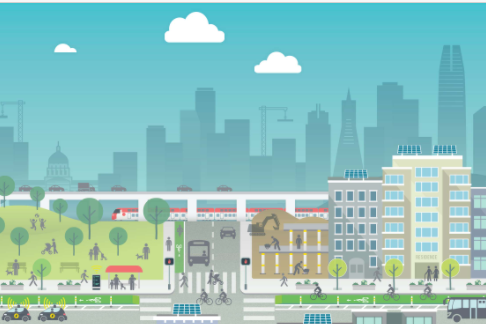
artist rendition of imagined streetscape with trains, cars, bicycles and pedestrians

With limited space on San Francisco city streets, how can we ensure that current and future transportation options remain accessible and affordable to all?

The San Francisco County Transportation Authority (SFCTA), the SFMTA and the San Francisco Planning Department are collaborating through ConnectSF in creating a template for an equitable, sustainable and effective future. Their Streets and Freeways Strategy examines approaches that support San Francisco’s Transit-First, Vision Zero, climate action, and equity goals.  The strategy complements the Transit Investment Strategy released in April 2021.

SFMTA staff provided expertise in developing the strategy and is leading the Active Transportation component, exploring ways to build a connected network of bike and pedestrian routes across the city that make biking and walking safe and enjoyable. SFMTA staff from across the agency also developed strategies to manage our limited street space effectively, focusing on moving the most people with space-efficient and low-polluting modes, and prioritizing people who have the fewest choices..

To learn about ConnectSF’s strategy for connecting neighborhoods, supporting the economy and creating a more welcoming environment, join their virtual town hall on Wednesday, July 21, 2021 at 5:30 pm-6:30 pm . That event will give participants insight into investing in San Francisco’s streets, prioritizing transit and carpooling, building out a complete walking and biking network, targeting safety, and repairing historical harms to communities.

To read more and provide feedback, visit the Strategy and complete the survey by July 31, 2021.


Published July 15, 2021 at 12:45AM
https://ift.tt/3ieHaTM

mercredi 23 juin 2021

A Look Back at Muni's Original Headquarters

A Look Back at Muni's Original Headquarters
By Jeremy Menzies

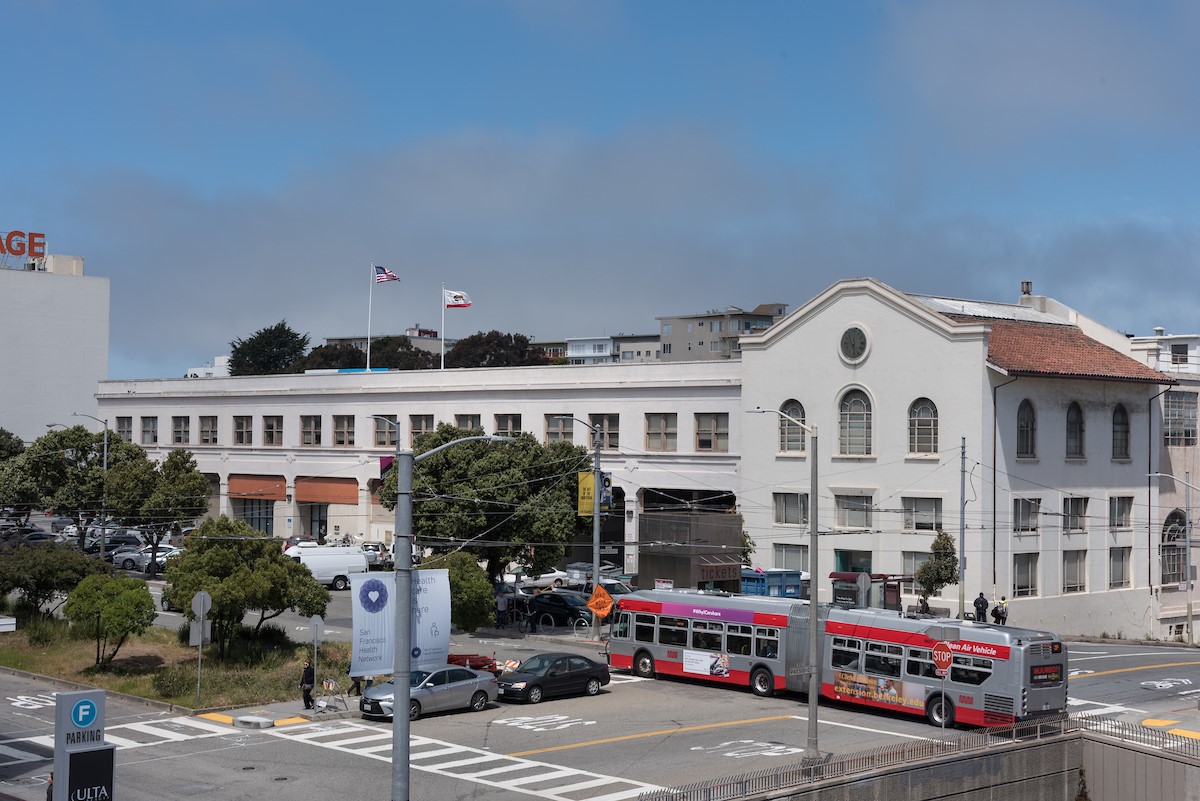
Located on the corner of Geary Boulevard and Presidio Avenue is a historically significant yet frequently overlooked public transit facility. Known today as Presidio Division, this massive building was home to Muni's headquarters for nearly 100 years. Here’s a quick look back through time at the history of this 109-year-old property.

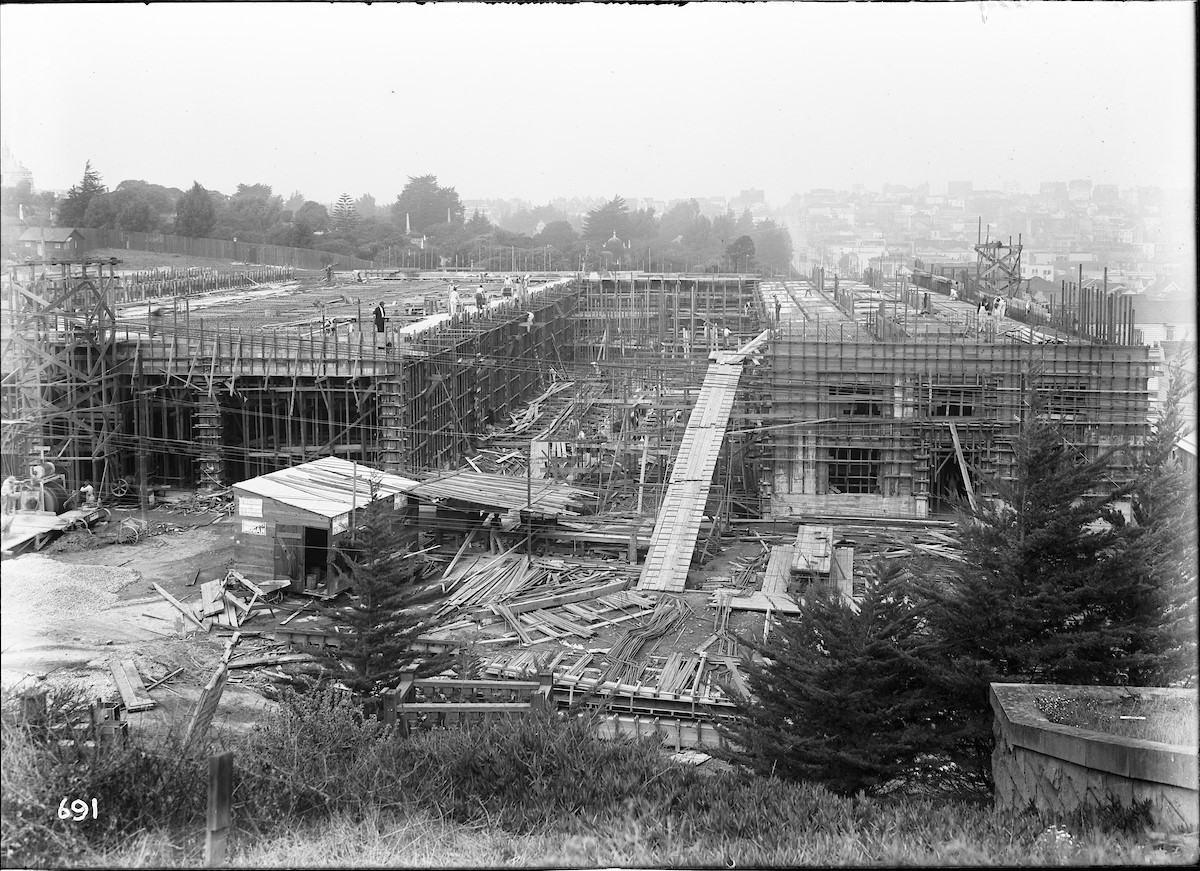
 In-progress construction of Muni’s headquarters in October 1912, two months prior to the opening of the city’s publicly owned streetcar line in December. This photo was taken from Calvary Cemetery, the present-day location of a shopping center.
In-progress construction of Muni’s headquarters in October 1912, two months prior to the opening of the city’s publicly owned streetcar line in December. This photo was taken from Calvary Cemetery, the present-day location of a shopping center.

Constructed in 1912 and known then as “Geary Car House”, this building was the operations hub of the San Francisco Municipal Railway, the nation’s first publicly owned transit agency in a major US city.  Built on bedrock from reinforced concrete, the original building had a shops and storage garages for streetcar operations, a three-story office tower, and an Art-Deco style relief sculpture above the bronze entrance doors on 949 Presidio Avenue.

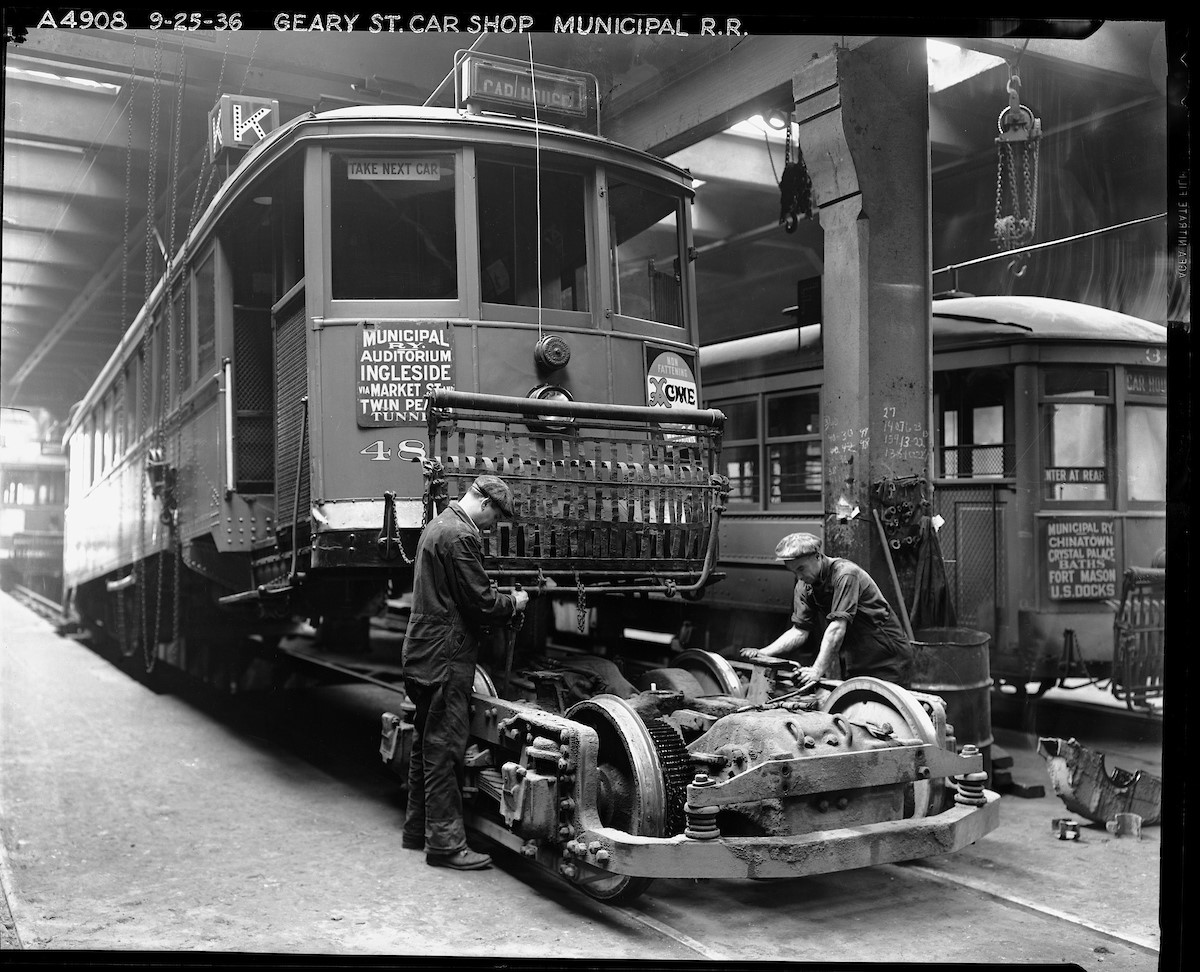
 Inside the shops at Geary Car House, two mechanics work on a truck (the combined wheels, suspension, and motor of the streetcar) pulled from a K Line streetcar in this 1936 photo.
Inside the shops at Geary Car House, two mechanics work on a truck (the combined wheels, suspension, and motor of the streetcar) pulled from a K Line streetcar in this 1936 photo.

In 1915, the rapidly expanding Muni system required more staff and more room, so a second story of offices was added above the streetcar storage and maintenance tracks along Geary. Inside the shops, staff did everything from repairing collision damage to overhauling electric motors and major mechanical parts.  

Following World War II, as many rail lines across the city were converted to bus operations, the days of streetcars at Geary came to an end.  In the late 1940s, a major project was undertaken to construct a yard and garages on the north end of the building for Muni’s growing fleet of electric trolley buses. After this renovation, the facility became known as Presidio Division.

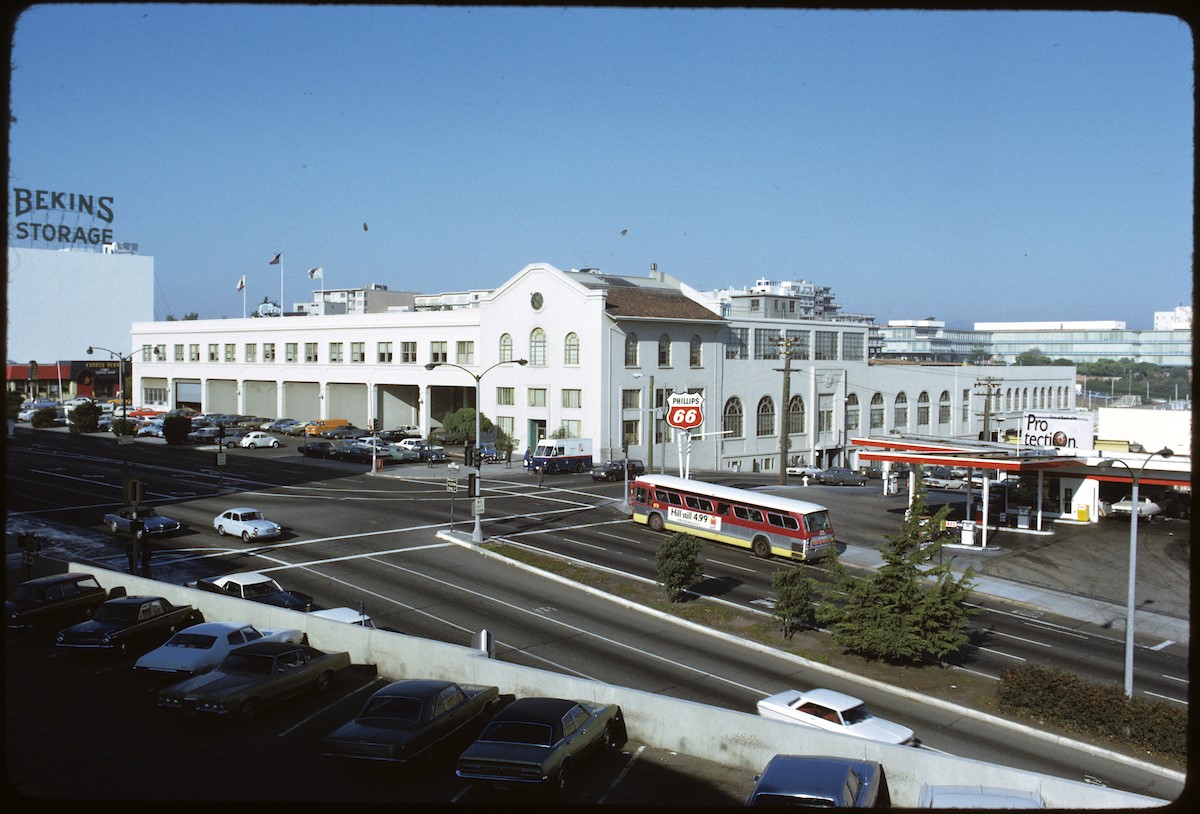
 This 1972 view was taken just one year prior to the construction of an underpass for Geary Boulevard that would allow traffic to bypass this area.
This 1972 view was taken just one year prior to the construction of an underpass for Geary Boulevard that would allow traffic to bypass this area.

In the years following the construction of the bus yard, the building saw various remodels to alter and update interior workspaces to meet the organization’s changing needs. The streetcar maintenance bays along Geary were even used to store the city’s voting machines.

Presidio remained Muni headquarters until the early 2000s, when most offices were moved to the Civic Center area to co-locate many of the functions of the fledgling SFMTA (formed by voter mandate in 1999). Following the move, Presidio has continued to serve as an operations and maintenance division for most of our 40-foot trolley buses as well as the primary offices for operator training and the Peer Assistance program.

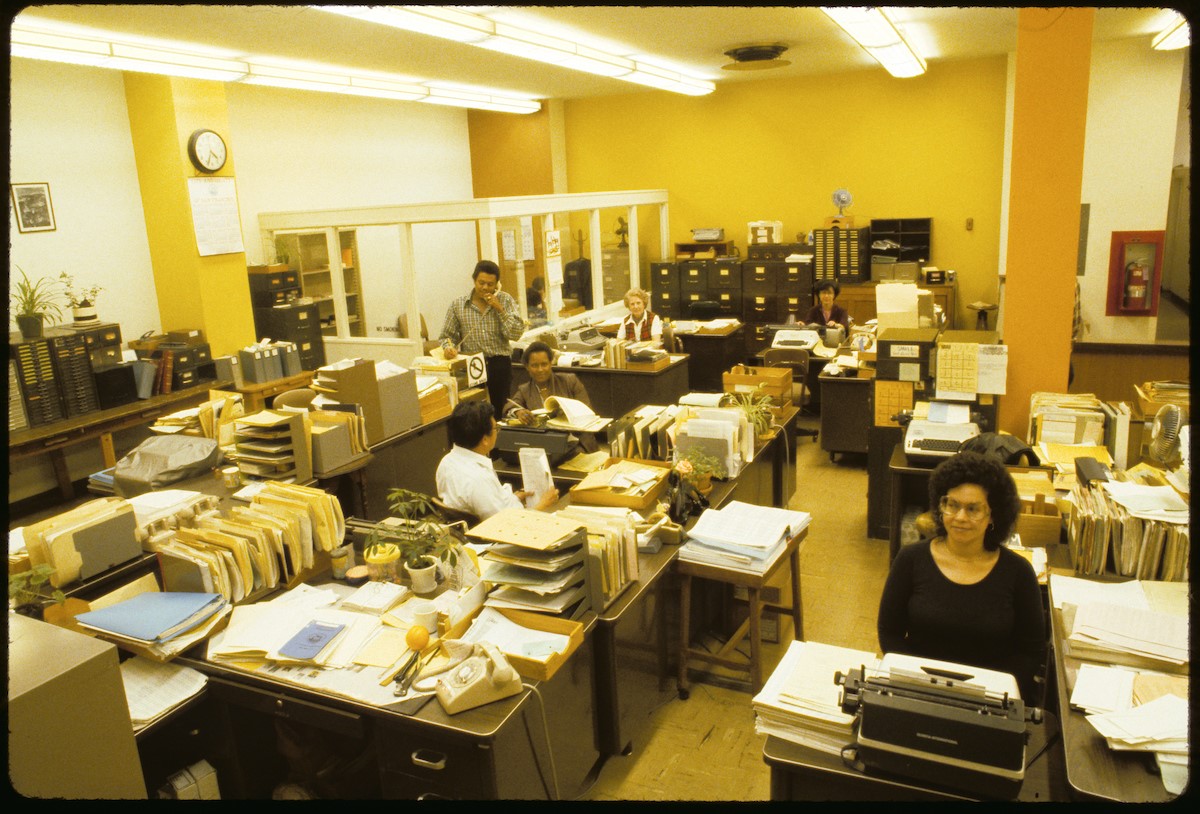
 Typewriters, paperwork, and file cabinets abound in this view inside one of the offices at Presidio Division in the late 1970s
Typewriters, paperwork, and file cabinets abound in this view inside one of the offices at Presidio Division in the late 1970s. 

Today, the building shows its age from years of use and is outdated compared to modern transit maintenance facilities, slowing down bus repairs.  Though repairs and remodels have been done to keep things operational, the Building Progress Program is seeking to completely revamp Presidio to help support reliable Muni service as part of the SFMTA’s long-term facilities plan.  

Typewriters, paperwork, and file cabinets abound in this view inside one of the offices at Presidio Division in the late 1970s

Today, 60-foot buses for the 38 and 38R routes are maintained at Presidio.

Check out more photos of Presidio Division through the years in our Historic Photos collection.


Published June 24, 2021 at 12:33AM
https://ift.tt/3qnTuVr

jeudi 17 juin 2021

SFMTA Street Changes Improve Safety in the Tenderloin

SFMTA Street Changes Improve Safety in the Tenderloin
By Samantha Serafica


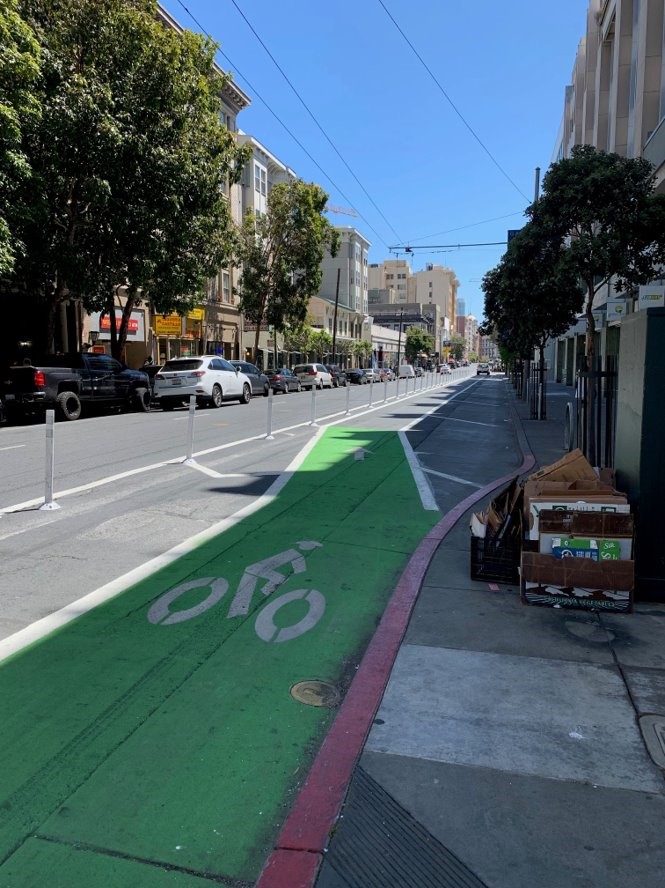
Protected bike lane and active flex space along the 300 block of Golden Gate

Protected bike lane and active flex space along the 300 block of Golden Gate

Between 2015-2019, the average rate of a person getting hit by a vehicle while walking or biking along the Tenderloin stretch of Golden Gate Avenue and Leavenworth Street was every nine days. The Tenderloin is a densely populated and diverse community located in the heart of San Francisco. It is home to high concentrations of seniors, children, people of color, people experiencing homelessness and people with limited-English proficiency – many of whom live below the poverty line. These groups are most at risk of dying or being severely injured in traffic collisions.

Because of these concerns, the SFMTA launched two quick-build projects on Golden Gate Avenue and Leavenworth Street with preliminary design phases in February 2020. Considering their similar traffic calming goals, physical proximity and shared audience, we pursued a joint outreach campaign for both projects. SFMTA staff began this outreach through door-to-door canvassing, walkalongs, in-person meetings and emails to engage directly with stakeholders and collect project feedback before starting design.

Facing the Pandemic

Unfortunately, public health restrictions associated with the emerging COVID-19 healthy emergency led to a hold on both projects so that staff could allocate resources to address other critical issues that began to arise. To address immediate social distancing and physical space needs in the Tenderloin, the SFMTA worked with community organizations like St. Anthony’s, GLIDE and Tenderloin Community Benefit District (TLCBD) to implement several street improvements such as block closures, physical distancing lanes and temporary vehicle restrictions.

When the projects resumed in fall 2020, COVID-19 health and safety protocols were still in effect and pushed many meetings, typically held in-person, to online formats. We also partnered with the Tenderloin People’s Congress to hold virtual toolkit forums, community workshops and other conversations.

In place of a traditional, one-time, in-person event, staff created a virtual open house with interactive features and information about the projects. Published in seven different languages, the site remained open over a five-week period, allowing greater flexibility for people to view the information and provide feedback. Staff also hosted virtual office hours to provide space for questions and additional comments. Following the virtual open house, both projects held a public hearing in April 2021 and were cleared to start construction in May.

Impact

Every street in the Tenderloin is on the city’s Vision Zero High Injury Network, the 13% of city streets where 75% of severe and fatal collision occur. The COVID-19 pandemic only exacerbated the challenges of addressing the safety needs of the neighborhood. Now, our recently constructed quick-builds on Golden Gate Avenue and Leavenworth Street are helping to address the unsafe vehicle speeds and failures to yield that have made up the majority of traffic incidents in the Tenderloin.  

The relationships built from the Safer Taylor project provided a foundation to continue conversations with the community about traffic safety improvements in the neighborhood. Staff began outreach through door-to-door canvassing, walkalongs, in-person meetings and emails to engage directly with stakeholders and collect project feedback before starting design.

Throughout construction, SFMTA staff continued to collaborate with local partners such as Code Tenderloin and TLCBD to provide construction notifications to businesses and residents on the corridors. Both Golden Gate and Leavenworth street changes brought innovative quick-build improvements to the Tenderloin, such as an active flex space, and bringing these projects to life under COVID-19 required creativity, flexibility and strong community support.

What’s Next

Partnering with community organizations allows SFMTA staff to engage with stakeholders that would have otherwise been unreachable due to public safety concerns. While quick-build construction is complete, our work in the Tenderloin will continue. Some next steps include evaluating the quick-builds, exploring potential future projects and transitioning some of our COVID-19 emergency streets to quick-build improvements. Community partnerships with local groups and individual residents will continue to sustain and strengthen our work in the Tenderloin.


Published June 18, 2021 at 12:23AM
https://ift.tt/3xv6Lhr